














- 256 Input Channels
- 128 Aux / Sub-Group Busses
- LR/LCR/5.1 Master Buss
- 48 x 48 Full Processing Matrix
- 688 Dynamic Equalizers
- 48/96 kHz Sample Rate
SD7 Quantum: Own The Room.
The fastest, smartest console ever created, SD7 Quantum delivers the functionality, audio performance and sheer scale required to deliver the largest productions now and in the future. With SD7 Quantum, you have the power to tackle any challenge and truly own the room.
Built to exceed the ambitions of tomorrow’s touring productions, SD7 Quantum breaks the barrier of seventh generation FPGA technology to deliver a dramatic leap forward in power and connectivity. All of this can be added to your existing SD7 surface, ensuring rental partners benefit from an even longer return on investment.
The result is a revolution of possibilities that towers above every other mixing platform available today.
Quantum – The Power of Three
Where once it was impossible to efficiently build an engine with more than one FPGA, now SD7 Quantum brings you the extraordinary might of three large-scale FPGAs working in unison.
Inside the Quantum engine, up to 2,000 channels can be transported across 688 processing paths at 96kHz. New GTX ports run at 6.6GHz while simple two wire connections ensure the fastest possible data speeds to reach a new pinnacle in mixing capability. Fully scalable and designed to communicate seamlessly with the next generation of FPGAs, the Quantum engine is a uniquely formidable platform for an ambitious industry.
Under The Hood
SD7 Quantum places the world’s most flexible and feature-rich mixing experience at your fingertips. Standard channel processing across both inputs and outputs includes Channel Delay, DiGiTuBe, Single and Multi-Channel Presets, Dual insert points, Hi- and Lo-pass filters at 24dB/octave, four-band parametric EQ (eight on outputs) with band curve selection and Dynamic EQ on each band, DiGiCo’s DYN 1 (Compressor, De-esser or Multiband Compressor) and DYN 2 (Gate, Compressor or Ducker).
All of this is before the arrival of Mustard Processing, a fully integrated suite of additional processing that can be assigned to any strip to boost your mix with a range of modelled preamps, vintage dynamics units and EQ sections, all only a touch away.
The master section incorporates 48 gangable 48 band graphic EQs, 48 stereo effects, and 36 control groups (VCAs); using snapshots, you can now switch between complete configurations in any live environment more quickly and easily than ever before, be it during rehearsals, set-up or even mid-show.
In addition, 128 busses are assignable as mono/stereo groups or auxiliaries, while a 48×48 output matrix, dual solo busses with True Solo, and a LR/LCR/5.1 Master buss is available for even deeper configurability.
Last but not least, with the inclusion of patented Nodal Processing, engineers now enjoy more creativity than was previously possible – for the first time, processing can be applied to any node on the auxiliary section of the console, allowing engineers to send unique processing on each send from single or multiple channels.
SD7 Quantum Features
- There is an arm processor, which handles all the communications between the host PC and the FPGA core; it’s the translator that communicates all the work surface flow to the core processor
- There are now three fourth-generation SHARCS controlling the interpolation algorithms in the FPGA to produce that warm analogue feel, which will make a significant difference to any engineer.
- Nodal Processing: The patented Nodal Processing appreciates the demands on monitor engineers and sound designers to be able to provide creativity not only on the channels but actually on each node of an aux buss. A full complement of processing can be allocated to the send allowing a unique mix tailored for the artist or the audience.
- True Solo: Allows the operator’s monitoring system to replicate almost any section of the console, and how that source is being processed and heard. This saves time and speeds up the process of managing the potentially daunting number of channels and busses available to the user.
I/O
The SD7 Quantum is renowned for its heavyweight I/O, and with good reason.
Local I/O: SD7 Quantum’s local I/O includes 12 analogue inputs, 12 analogue outputs and 12 AES I/O (mono)
Optocore: The amount of connectivity is very special. SD7 Quantum comes as standard with one Optocore fibre loop, which is 504 channels of audio; there can be up to 14 DiGiCo racks, or a combination of racks and tie-lines around the loop; and there is an option to upgrade to dual loop, which allows for 1,008 Optocore channels of audio and 28 racks running.
UBMADI: In addition, the engine has a 48-channel UBMADI, so you can connect any laptop via USB and get 48 channels of recording and playback.
DMI: We have also incorporated two dedicated DMI slots to accommodate the growing family of DiGiCo DMI card options. Allowing the console connectivity to be configured for the demand of the tour or event, so you could plug in a Dante module, or the latest automatic mic mixing module. Each dedicated DMI slot provides you with an additional 64 I/O.
Waves: There is also Waves connectivity if you want to utilise SoundGrid processing, giving you 64×64 additional I/O.
DMI-AMM
This card offers both the SD-Range and the S-Series consoles 48 channels of automatic microphone mixing which can be used in any console input channel.
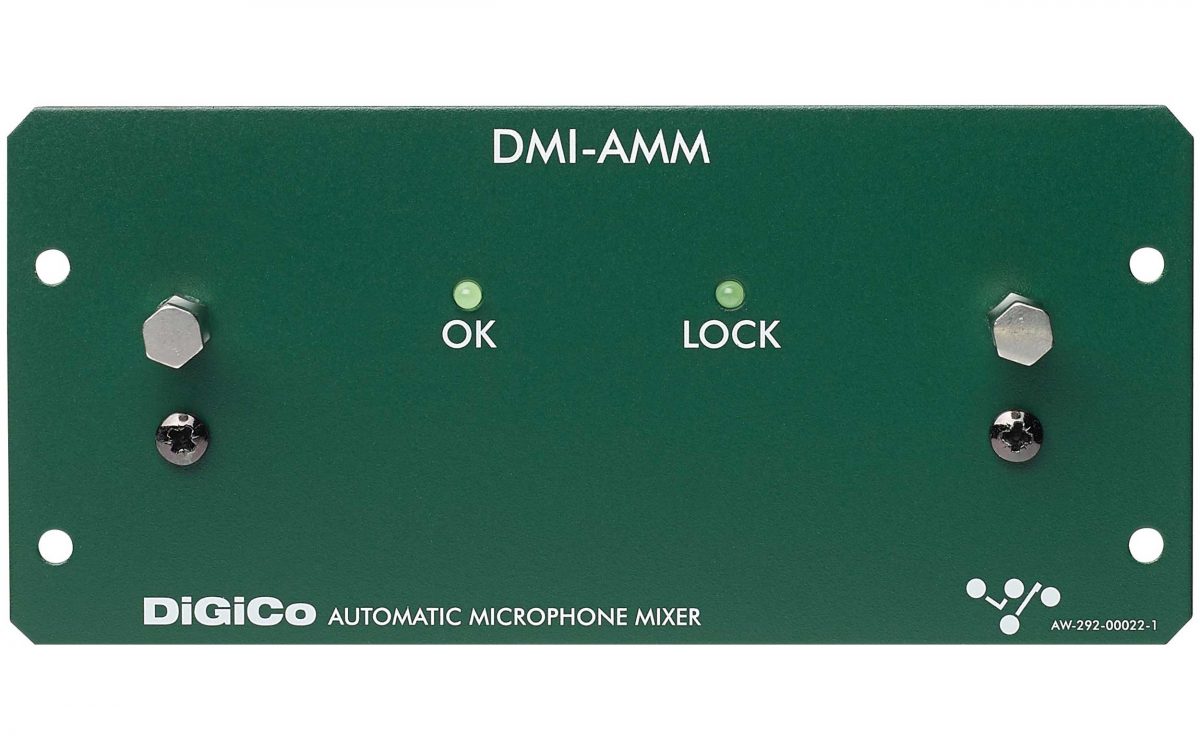
When dealing with live sound scenarios that involve several live microphones with unpredictable dialogue, mixing them can be a challenge for an engineer. DiGiCo are proud to offer the DMI-AMM (Automatic Mic Mixing) as a versatile solution for these issues.
The DMI-AMM system works by instantly fading up a microphone’s gain when one person begins to speak and reducing the gain of the other microphones. When the speaker pauses, all microphone levels return to medium gain, collectively matching the level of one microphone with the full gain share. The resulting effect is as if all speakers are sharing one microphone. When several people talk at once, the gain is shared between the speakers. Each channel is given a Share Meter, which is shown in percentage, not dB. This makes it easy to see what channels are taking the majority of the gain.
The DMI-AMM also allows adjustment of the relative sensitivity (or weighting) of the AMM on a per channel basis. This means that should one of the speakers be quieter than the others, they still have the ability to “take over” the system. Furthermore, the card features a vital noise floor control that imposes a lower limit on the level detector of all mics in the AMM to prevent a noisy mic from catching a disproportionate share of the gain.
This card offers both the SD-Range and the S-Series consoles two independent 48 channel automatic microphone mixers which can be used on any console input channel. Both the S-Series and SD-Range allow a Virtual AMM so that the AMM routing and parameters can be set before a card is inserted.
Main Features
- Two independent 48 channel automatic microphone mixers
- Weighting control on a per channel basis
- Share meter in percentage to show which channels are taking the majority gain share
- Noise floor control
- Simple integration into both the S-Series and the SD-Range software
- Virtual AMM to set up a session before the card is present
- Compatible with S-Series, SD12 and Quantum Range

DMI-ADC
This card provides 16 analogue inputs on 2 x 25 way “D” connectors. The ADC card is a line card only. There is no microphone amplifier or phantom power available. There is no gain control function for these inputs (only digital trim). Maximum input level +22dBu.

As a simple solution to expanding the local i/o of the S-Series, DiGiCo offer the DMI-ADC and the DMI-DAC. Both use 2 x 25 way “D” connectors to add either 16 analogue inputs or 16 analogue outputs. Both cards are compatible with S-Series, Quantum Range, SD12, Orange Box and 4REA4.
Main Features
- 16 analogue inputs
- 2 x 25 way “D” connectors
- Compatible with S-Series, Quantum Range, SD12, Orange Box and 4REA4

DMI-AES
This card provides 16 Inputs (8 pairs) and 16 outputs (8 pairs) on 2 x 25 way “D” connectors. All AES inputs are provided with sample rate conversion (SRC) by default. All AES outputs are synchronised to the mixer system clock.

Developed by the Audio Engineering Society (AES) and the European Broadcasting Union (EBU), this digital audio format was originally developed in 1985 and was the first professional digital audio format to gain widespread acceptance. There have been several revisions over the years. Also known as AES3 or IEC-60958 Type I, the data protocol includes up to two channels of up to 24-bit audio running at sample rates up to 96 kHz.
Multi-channel digital audio formats such as MADI have become popular, but AES3 is still a very useful format to distribute stereo signals (such as L/R mixer output) or to integrate stereo signal processors such as reverbs.
The DMI-AES provides 16 Inputs (8 pairs) and 16 outputs (8 pairs) on 2 x 25 way “D” connectors. All AES inputs are provided with sample rate conversion (SRC) by default. All AES outputs are synchronised to the mixer system clock.
Main Features
- 2 x 25 way “D” connectors
- 16 inputs (8 pairs) and 16 outputs (8 pairs)
- Sample rate conversions on all inputs
- Compatible with S-Series, Quantum Range, SD12, Orange Box and 4REA4

DMI-AVIOM
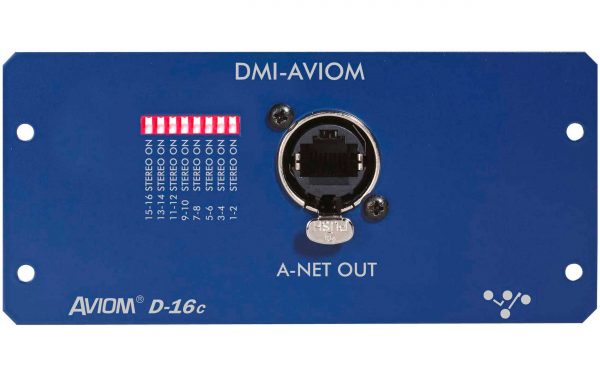
This card provides 16 output channels at 48kHz (with SRC) and Supports Aviom's proprietary A-Net Pro16 protocol. It has 1 Ethercon connection and faceplate DIP switched for Stereo output selection.

The DMI-AVIOM allows easy integration with Aviom’s personal monitoring systems through the use of their A-Net protocol. The card provides 16 output channels (8 stereo) at 48kHz with inbuilt sample rate conversion for seamless compatibility with consoles running at 48kHz or 96kHz and supports Aviom’s proprietary A-Net Pro16 protocol. It has 1 Ethercon connection and faceplate DIP switches for stereo output selection.
Main Features
- 16 output channels (8 stereo)
- Faceplate DIP switches for stereo output selection
- Inbuilt sample rate conversion
- Compatible with S-Series, Quantum Range, SD12, Orange Box and 4REA4
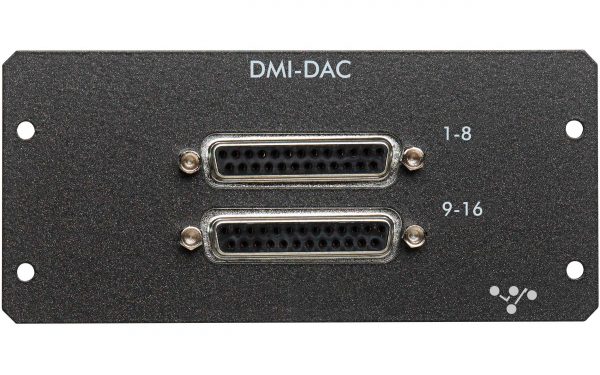
DMI-DAC
This card provides 16 analogue outputs on 2 x 25 way “D” connectors DAC card is line level only. Maximum output level +22dBu (Digital Full Scale)
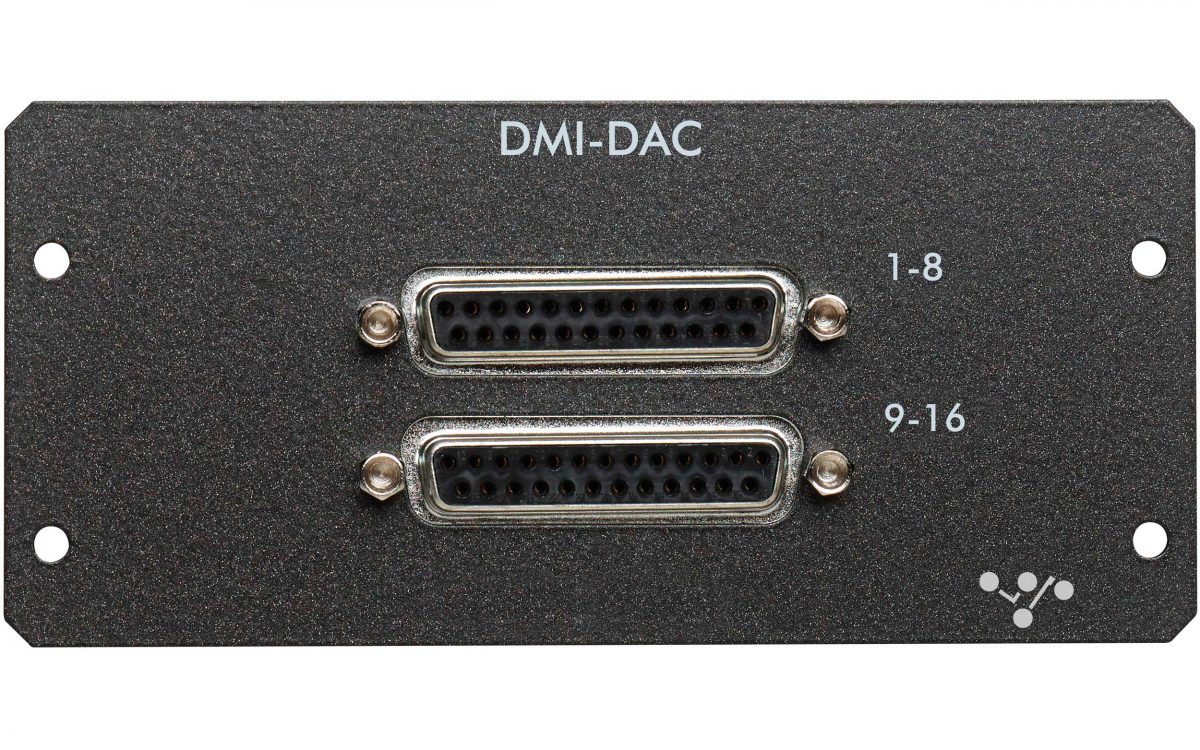
As a simple solution to expanding the local i/o of the S-Series, DiGiCo offer the DMI-ADC and the DMI-DAC. Both use 2 x 25 way “D” connectors to add either 16 analogue inputs or 16 analogue outputs. Both cards are compatible with S-Series, Quantum Range, SD12, Orange Box and 4REA4.
Main Features
- 16 analogue outputs
- 2 x 25 way “D” connectors
- Compatible with S-Series, Quantum Range, SD12, Orange Box and 4REA4
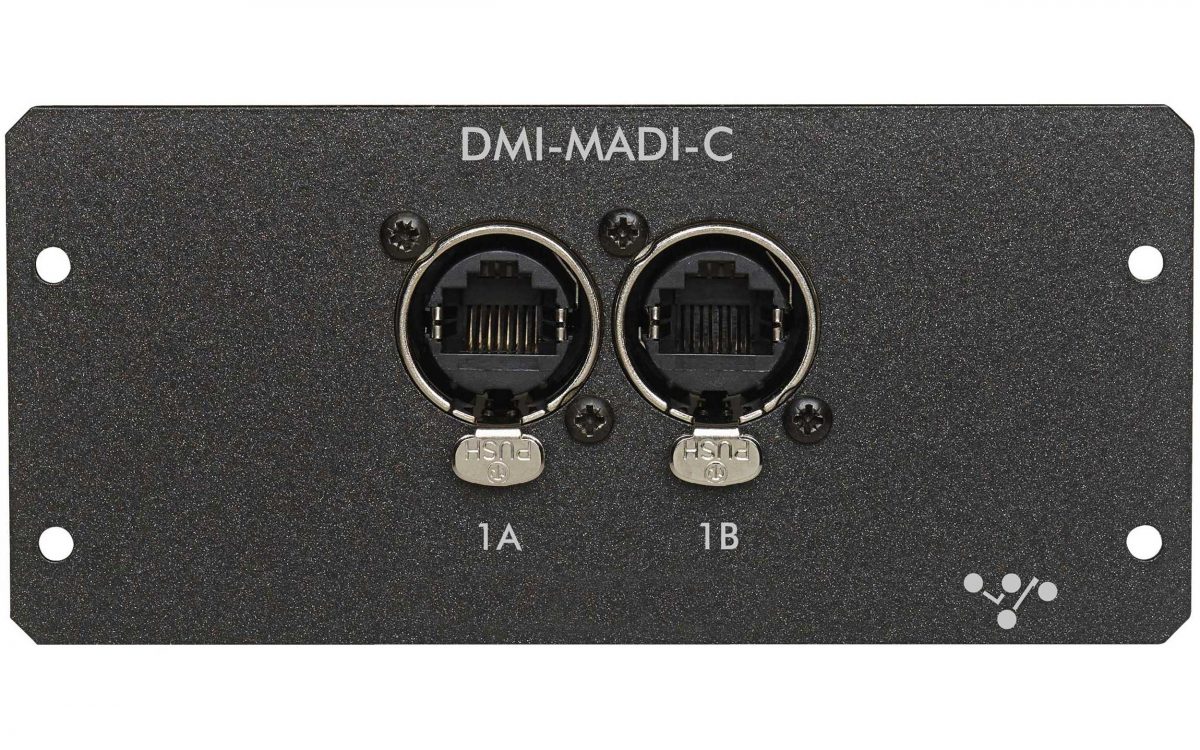
DMI-MADI-C
This card can be used to connect another DiGiCo device that uses RJ45 Standard MADI (64 channels in and out) at 48KHz or 96KHz or an SD Series DiGiCo Rack with the appropriate connector (D-Rack, D2-Rack)
MADI (Multichannel Audio Digital Interface) is arguably one of the most popular protocols for transmitting high channel counts in professional audio. This is partially due to its ease of use, and the ability for cables to be run long lengths with minimal signal loss. Originally only capable of transmitting 56 channels, MADI is now capable of transmitting up to 64 channels.
DiGiCo offers two MADI DMI cards, each with different connector types. Both the MADI-B (BNC) and the MADI-C (RJ45) cards can be used to connect up to 64 channels of audio in and out at both 48kHz and 96kHz. At 48kHz, the B connection can be used as a redundant audio stream. Should the A stream fail during use, the B stream will seamlessly take over. At 96kHz, the B connection must be connected to provide the full channel count.
Main Features
- RJ45 connection
- 64 channels in and out at 48kHz and 96kHz
- Redundancy if working at 48kHz
- Only for use with DiGiCo audio over Cat5 devices
- Internal switches to determine whether connected to a console or a rack
- Compatible with S-Series, Quantum Range, SD12, Orange Box and 4REA4

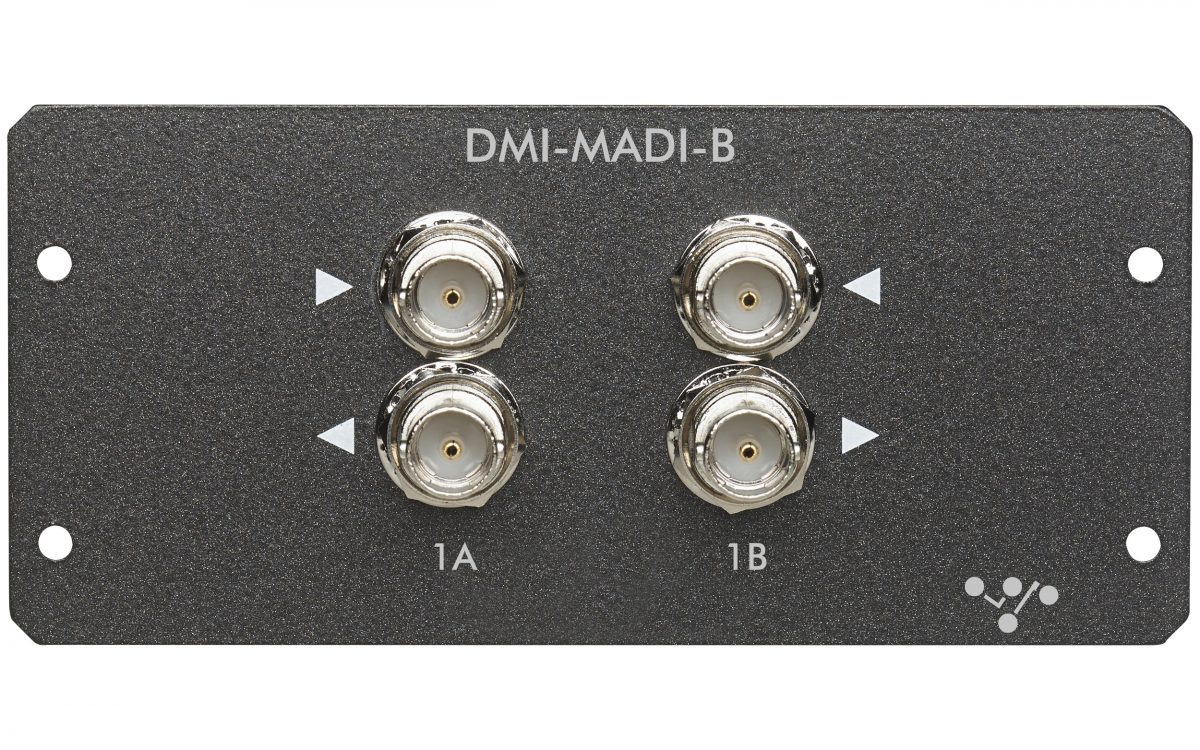
DMI-MADI-B
This card can be used to connect a Standard MADI stream (64 channels in and out) at 48KHz or 96KHz or an SD Series DiGiCo Rack with the appropriate connector (D2-Rack, SD-Rack, SD-MINIRack)
MADI (Multichannel Audio Digital Interface) is arguably one of the most popular protocols for transmitting high channel counts in professional audio. This is partially due to its ease of use, and the ability for cables to be run long lengths with minimal signal loss. Originally only capable of transmitting 56 channels, MADI is now capable of transmitting up to 64 channels.
DiGiCo offers two MADI DMI cards, each with different connector types. Both the MADI-B (BNC) and the MADI-C (RJ45) cards can be used to connect up to 64 channels of audio in and out at both 48kHz and 96kHz. At 48kHz, the B connection can be used as a redundant audio stream. Should the A stream fail during use, the B stream will seamlessly take over. At 96kHz, the B connection must be connected to provide the full channel count.
Main Features
- 75Ω Coaxial (BNC) connections
- 64 channels in and out and 48kHz and 96kHz
- Redundancy if working at 48kHz
- For use with any standard BNC MADI audio device
- Compatible with S-Series, Quantum Range, SD12, Orange Box and 4REA4

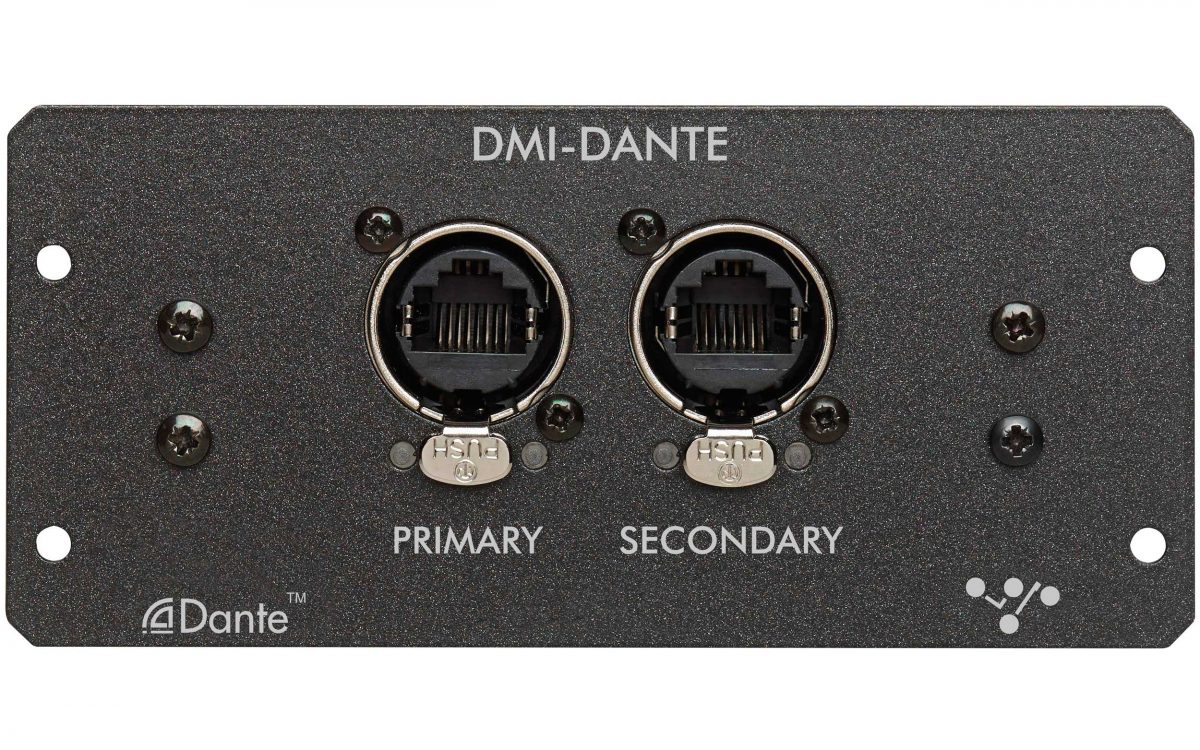
DMI-DANTE
This card provides 64 input and 64 output channels at 48KHz and 32 input and 32 output channels at 96KHz. It is provided with Primary and Secondary (backup) Gigabit Ethercon ports for connection to the Dante network.
Audio over IP is becoming more and more sought after, due to the fact that it works over a standard IP network and can be sent over pre-installed infrastructure. Developed by Audinate in 2006, Dante provides uncompressed, low latency, multi-channel digital audio over IP and is a popular choice of protocol.
DiGiCo offer a Dante interface that allows 64 channels in and 64 channels out at 48kHz, and 32 channels in and out at 96kHz. The DMI-DANTE has a Primary and a Secondary port, both of which are Ethercon ports. The card has two modes that can be changed in Dante Controller. In Switched Mode, the ports are switched together. In redundant mode, the ports work as a redundant pair with separate IP addresses so that if the primary connection fails, the secondary connection will take over.
Main Features
- 2 Ethercon ports
- Switched mode switches the ports together
- Redundant mode allows the ports to work as a redundant pair
- 64 channels in and 64 channels out at 48kHz
- 32 channels in and 32 channels out at 96kHz
- Compatible with S-Series, Quantum Range, SD12, Orange Box and 4REA4

SD7 Quantum Specifications
General Specifications
- Faders 38 x 100mm touch-sensitive, motorised + 14 x 60mm touch sensitive, motorised
- Screens 3 x 15” LCD high – resolution touch screens
- Meterbridge 3 x Custom Mounted LCD high-resolution TFT-LCD screens
- Redundancy Internal removable engine x 2
- Internal hot-swappable PSU x 2
- Processing Channels Up to 432 (combination of Input Channels / Aux / Solo Group Busses)
- Busses Up to 128 Aux / Group busses with full processing Mono / Stereo / LCR / 5.1
- Matrix Up to 48 Input / 48 Outputs with full processing
- Control Groups Up to 36, selectable for VCA-style, Moving fader, Mute Group
- Graphic Eq 48 x 32-band, Gain +/- 12dB
- Internal FX Up to 48 stereo effects comprising 16 floating point reverbs and 32 delay/chorus/pitch/enhancer
- Local I/O 12 x mic/line I/O, 12 x AES I/O
- 8 x MADI interfaces @ 48kHz, 4 redundant interfaces @ 96kHz, BNC connectivity
- Standard Optocore (Dual Loop – Optional)
- Sampling rates 48kHz / 96kHz
- GPIO: 2 x DSub37 – 16 as standard, expandable to 32
- Video Inputs x 2, Outputs x 2
- DMI: 2 x DiGiCo Multichannel Interface
- Waves: Fitted as Standard
- Ext Sync Wordclock, AES, Video, MADI, Optocore
- SD7 Quantum Dimensions: 1496mm (w) x 875mm (d) x 503mm (h)
- SD7 Quantum Weight 141Kg / 311lbs (245Kg / 540 lbs. with flightcase)
- SD7 Quantum Flightcase: 1600mm (w) x 600mm (d) x 1240mm (h)
- Power Requirements 90V-260V, 50-60Hz, 600VA
Audio Specification
- Sample Rate: 48kHz or 96kHz
- Processing Delay: 2ms Typical @ 48k (253 Channels, Stage Input Through L-R Buss to Stage Output) 1.1ms @96k
- Internal Processing: Up to 40-bit, Floating Point
- A>D & D>A: 24-bit Converter Bit Depth
- Frequency Response: +/- 0.6dB (20Hz – 20kHz)
- THD: <0.05% @ Unity Gain,: 10dB Input @ 1kHz
- Channel Separation: Better Than 90dB: (40Hz – 15kHz)
- Residual Output: <90dBu Typical
- Noise: (20Hz – 20kHz)
- Microphone Input: Better Than -126dB: Equivalent Noise
- Maximum Output Level: +22dBu
- Maximum Input Level: +22dBu
Processing Channel Specification
Input Channel
- Name: User-Defined / Presets
- Channel Selection: Mono / Stereo / Multi
- Input Routing: Main & Alternate Input
- Analogue Gain: -20 to +60dB
- Phase: Normal / Reverse
- Digital Trim: -40 to +40dB
- Delay: >1 Sec (Coarse & Fine Control)
- DiGiTuBe: Drive 0.01 – 50.0
- Bias 0 – 6
- LPF: 20 – 20kHz, 24dB/Oct
- HPF: 20 – 20kHz, 24dB/Oct
- Insert A: (Pre EQ/Dyn) On/Off
- Equalisation: 4 Band EQ: Parametric or Dynamic (Low/Lowshelf, Lower-Mid/Lowshelf, Upper-Mid/
Hi Shelf, Hi/Hishelf)
On/Off
Freq; 20 – 20kHz
Gain; +/- 18dB
Q: 0.1 -20 (Parametric) / 0.10-0.85 (Shelf)
Dynamic EQ On/Off
Over/Under
Band On/Off
Threshold; -60 – 0dB
Attack; 500us – 100ms
Release; 10ms – 10s
Ratio; 1:1 – 50:1 - Dynamics 1: Single or Multiband (3-Band) Compressor: On/Off
Threshold; -60 – 0dB
Attack; 500us – 100ms
Release; 10ms – 10s
Ratio; 1:1 – 50:1
Gain; 0 to +40dB with
Autogain Option
Link; Any Channel/Buss
Hi Crossover; 20Hz – 20kHz
Lo Crossover; 20Hz – 20kHz
Knee : Hard, Med, Soft De-Esser: Threshold : 20us – 20ms
Release : 1ms – 100ms
Ratio : 1:1 – 50:1
Ess-Band : Listen On/Off
Ess-Band Filter Freq / Width: 20Hz – 20kHz - Dynamics 2: On/Off Gate / Ducker: Threshold; -60 – 0dB
Attack; 50us – 100ms
Hold; 2ms – 2s
Release; 5ms – 5s
Range; 0 – 90dB
Key; Any Source
Key Listen
Freq/Width; 20 – 20kHz Compressor: On/Off
Threshold; -60 – 0dB
Attack; 500us – 100ms
Release; 10ms – 10s
Ratio; 1:1 – 50:1
Gain; 0 to +40dB with
Autogain Option
Link; Any Channel / Buss
Hi Crossover; 20Hz – 20kHz
Lo Crossover; 20Hz – 20kHz
S/C Source : Any Source
S/C Listen : On/Off
S/C Filter Freq/Width: 20Hz – 20kHz - Insert B: (Post EQ/Dyn) On/Off
- EQ/Dyn order: EQ/Dyn or Dyn/EQ
- Mute: Channel Mute / Hard Mute
- Solo: Solo Buss 1 / Solo Buss 2 / Both, Auto Solo
- Channel Safe: Input, EQ, Dyn, Aux, Pan, Fade/Mute, Inserts, Buss, Directs,
Full Safe - Output Routing: Buss, Insert A, Insert B, FX
Direct: On/Off, Pre-Mute / Pre-Fade / Post-Fade, Level +/- 18dB - Fader: 100mm Motorised Fader ∞ to +10dB
Processing Channel Specification
Aux / Group / Matrix Output
- Name: User-Defined / Presets
- Phase: Normal / Reverse
- Digital Trim: -20 to +60dB
- Delay: >1 Sec (Coarse & Fine control)
- DiGiTuBe: Drive 0.01 – 50.0
Bias 0 – 6 - LPF: 20 – 20kHz, 24dB / Oct
- HPF: 20 – 20kHz, 24dB / Oct
- Insert A: (Pre EQ/Dyn) On/Off
- Equalisation: 8 Band EQ: 4 band Parametric and 4 band parametric or Dynamic (Low/Lowshelf, Lower-Mid/Lowshelf, Upper-Mid/Hi Shelf, Hi/Hishelf)
On/Off
Freq; 20 – 20kHz
Gain; +/- 18dB
Q: 0.1 -20 (Parametric) / 0.10-0.85 (Shelf)
Dynamic EQ On/Off
Over/Under
Band On/Off
Threshold; -60 – 0dB
Attack; 500us – 100ms
Release; 10ms – 10s
Ratio; 1:1 – 50:1 - Dynamics 1: Single or Multiband (3-band) Compressor: On/Off
Threshold; -60 – 0dB
Attack; 500us – 100ms
Release; 10ms – 10s
Ratio; 1:1 – 50:1
Gain; 0 to +40dB
with Autogain Option
Link; Any Channel / Buss
Hi Crossover; 20Hz – 20kHz
Lo Crossover; 20Hz – 20kHz
Knee : Hard, Med, Soft De-Esser: Threshold: 20us – 20ms
Release: 1ms – 100ms
Ratio: 1:1 – 50:1
Ess-Band: Listen On/Off
Ess-Band Filter Freq/Width: 20Hz – 20kHz - Dynamics 2: On/Off Gate / Ducker: Threshold; -60 – 0dB
Attack; 50us – 100ms
Hold; 2ms – 2s
Release; 5ms – 5s
Range; 0 – 90dB
Key; Any Source
Key Listen
Freq/Width; 20 – 20kHz Compressor: On/Off
Threshold; -60 – 0dB
Attack; 500us – 100ms
Release; 10ms – 10s
Ratio; 1:1 – 50:1
Gain; 0 to +40dB
with Autogain Option
Link; Any Channel/Buss
Hi Crossover; 20Hz – 20kHz
Lo Crossover; 20Hz – 20kHz
S/C Source : Any source
S/C Listen : On/Off
S/C Filter Freq/Width: 20Hz – 20kHz - Insert B: (Post EQ/Dyn) On/Off
- EQ/Dyn Order: EQ/Dyn or Dyn/EQ
- Mute: Channel Mute / Hard Mute
- Solo: Solo Buss 1 / Solo Buss 2 / Both, Auto Solo
- Channel Safe: Trim, EQ, Dyn, Fade/Mute, Inserts, Outputs, Full Safe
- Output Routing: Outputs, Insert A, Insert B, FX
- Fader: 100mm Motorised Fader ∞ to + 10dB
SD7 Quantum Downloads
| TN325 SD Apple Airport | DOWNLOAD | |
| TN324 SD series iPad external control setup | DOWNLOAD | |
| TN319 Use of Optocore units with Digico systems | DOWNLOAD | |
| TN300 SD Optocore wordclock operation description | DOWNLOAD | |
| TN299 SD MADI redundant operation description | DOWNLOAD | |
| TN296 Recording to MADI with Digico systems | DOWNLOAD | |
| TN294 SD series MADI implementation description | DOWNLOAD | |
| TN269 SD series recovery system description | DOWNLOAD | |
| TN266 SD-Rack I/O Levels (Also applies to SD7 Local I/O) | DOWNLOAD | |
| TN242 SD7 Touch calibration | DOWNLOAD | |
| TN214 SD7 Jumper Settings | DOWNLOAD | |
| TN195 SD Series Network Settings | DOWNLOAD | |
| TN70 UPS and power consumption all products | DOWNLOAD | |
| TB112 SD series GPIO pinouts | DOWNLOAD | |
| TB106 Madi cable specifications | DOWNLOAD | |
| TB101 Optical cable specifications | DOWNLOAD |