













DiGiCo SD8

- 120 Input Channels
- 48 Aux / Sub-Group Busses
- LR/LCR/LCRS Master Buss
- 16 x 16 Full Processing Matrix
- 190 Dynamic Equalizers
- 48/96kHz Sample Rate
DiGiCo SD8: The Price Performance breakthrough
Relish the exceptional versatility of the SD8 – featuring the same Stealth Digital Processing and floating point Super FPGA technology as the flagship SD7, the SD8 has been engineered to provide an intuitive workflow and infinite expansion possibilities to enhance your live performance mixing experience.
Choose between two versions of the SD8: 37 feature-packed channels arranged in three banks of 12 motorised faders and one master fader; or 24 channels, providing the same power and functionality in a more compact frame.
You’ll feel right at home with the SD8 console’s worksurface: a 15-inch, high resolution TFT LCD touch screen with backlit display that allows you to assign any bank of 12 faders as input or output channels, allowing all 36 main faders to control inputs if desired; or to the touch screen for fine-tuning. Dedicated multi-function control knobs and electronic labelling facilitate your work process.
Under The Hood
Underpinning the SD8’s versatility are 120 input channels at 48kHz/96kHz, offering channel processing across both inputs and outputs of Channel Delay, Single and Multi-Channel Presets, Dual insert points, Hi- and Lo-pass filters @ 24dB/octave, four-band parametric EQ with band curve selection, DiGiCo’s DYN 1 (Compressor, De-esser or Multiband Compressor) and DYN 2 (Gate, Compressor or Ducker).
Any of the powerful 190 Dynamic EQ processors can be assigned to any of the input or output channels, offering dynamic processing on each of the four standard parametric bands, in addition to the 190 Multiband Compressors and 190 DiGiTuBes. Regardless of how the console is set up all the channels are equipped to provide the same high quality signal path and feature set.
The master section incorporates 24 gangable 32-band graphic EQs, 16 stereo effects (selectable from a palette of 33), and 24 control groups (VCAs); and using snapshots, you can switch between complete configurations in any live environment easier than ever before, be it at rehearsals, during system setup, or even at a show.
In addition, 48 busses are assignable as mono/stereo groups or auxiliaries, while a 16×16 output matrix, dual solo busses, and a Master buss is available for even deeper configurability.
I/O
The SD8 offers local I/O in abundance: eight mic inputs, eight outputs, eight mono AES I/O, and two MADI connections. It comes as standard with an 8U fixed 48 input / 8 analogue output D2 Rack, with the ability to increase output count to 24 with any combination of analogue AES/EBU or Aviom. SD-Rack, SD-Mini, SD-Nano Rack or D-Rack connections are also available, as well as a factory fit Optocore option which allows for connectivity to all DiGiCo racks and consoles in a redundant loop.
Get instant access to 32 fully integrated low-latency Waves stereo MultiRacks, each with up to eight plug-ins per rack, by fitting an optional DiGiCo SoundGrid module linked to external SoundGrid or DiGiGrid servers, giving a total of 128 additional I/O.
SD8 I/O Racks & Options
The I/O rack that has it all

- 14 card module slots - 56 inputs and 56 outputs
- Fully compatible with our industry leading 32bit SD cards
- 192kHz high resolution ready
- HMA Optics
- Redundant power supplies
- Proven touring ready rugged design
DiGiCo I/O enters the next generation
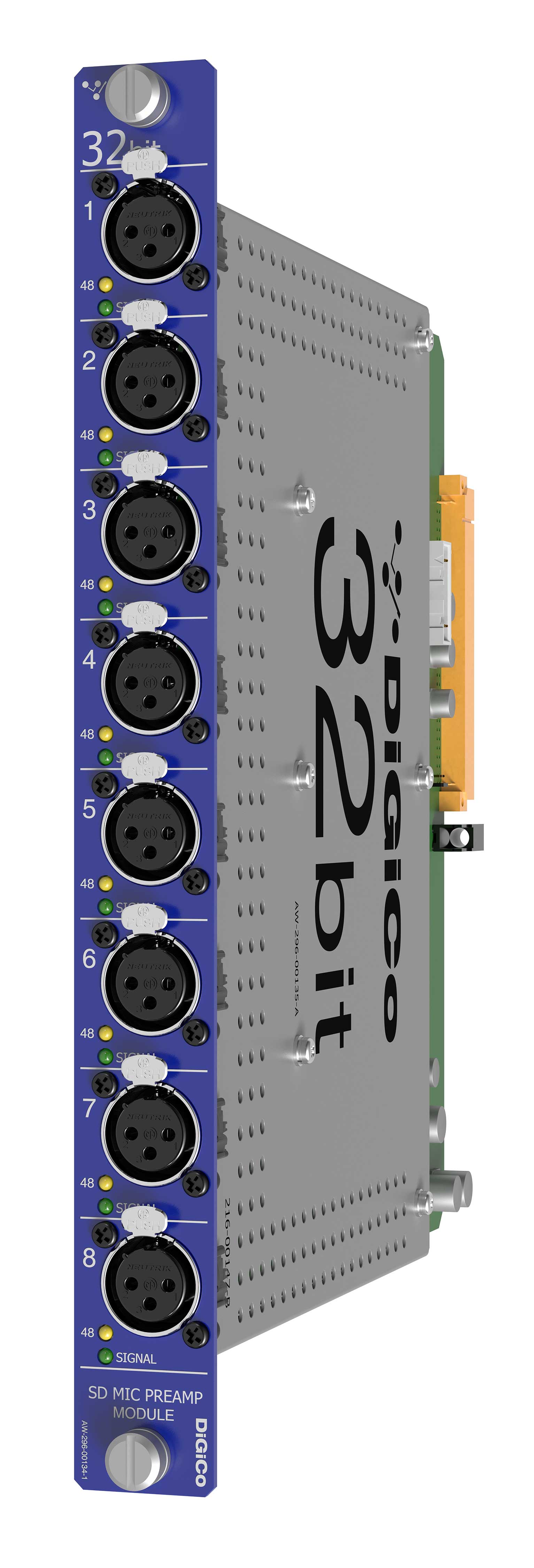
With support for up to 192kHz high resolution analogue I/O converters plus a comprehensive range of digital formats, it’s no wonder that the SD-Rack is accepted as the finest I/O rack available. From MADI to AES/EBU, Dante, AES-42, ADAT, or Aviom, the SD-Rack has it all.
Based on the same Stealth FPGA technology as the world-renowned SD-Range of consoles, the SD-Rack can run on the optical loop at 96KHz, while providing a down-sampled 48KHz feed from one of the MADI output streams; ideal for a broadcast truck split. The result is industry-leading A/D conversion complete with DiGiCo’s famous Gain Tracking™, meaning all consoles benefit from +/-40dB of digital gain.
Once a user has set the gain on each channel, every console on the loop can Gain Track their own mixes, and if any tweaking of analogue gain settings is required then each Gain Tracked channel will automatically compensate to ensure the mix remains the same. Best of all, should clipping occur, any of the consoles on the loop can take control of an analogue gain and make the necessary adjustments without affecting anyone else’s mix.
The SD-Rack’s 14 slots give you up to 56 inputs and 56 outputs, and users can choose whether to include the Optocore optical fibre connectivity or connect the SD-Rack to the console using MADI. When running at 48kHz, the two MADI ins and outs provide 56 fully redundant input and output channels via duplicate connections. When running at 96kHz, the SD-Rack delivers a full complement of 56 channels of MADI across the dual MADI ports.
Lastly, for ease of use the SD-Rack offers hot swappable interface cards with are automatically identified and configured, plus a top-mounted, hot swappable power supply.
No matter the size of the rack you choose, up to 14 DiGiCo I/O racks can run on a single optical loop, while as many as 28 can be accommodated on a dual loop system. This, coupled with the ability for any of the five consoles that can sit on one optical loop to receive all inputs and individually address output slots on any rack, gives the engineer or system designer unprecedented versatility.
SD-Rack I/O Modules




SD-Rack
Compact, flexible and powerful DiGiCo I/O
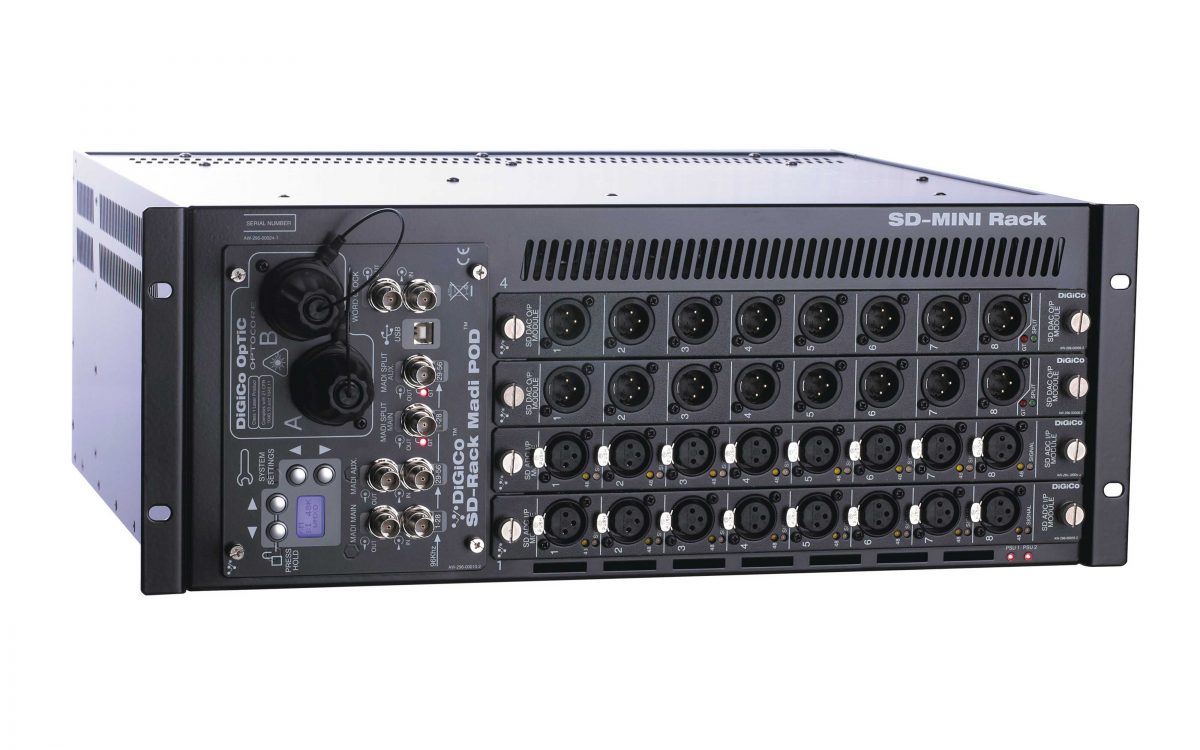
- Compact 4U Rack
- 4 card slots for up to 32 I/O
- Optical or MADI connectivity
- Supports the full range of SD card options
A 4U stage box packed with I/O
Crammed with I/O but occupying just 4U, the SD-MiNi Rack joins the SD and SD-Nano racks as part of DiGiCo’s comprehensive family of high sample rate, remote rack solutions to meet any and every requirement.
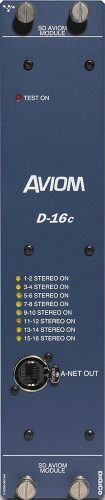
The SD-MiNi accepts both analogue and digital input and output cards including AES/EBU, Dante, AES-42, ADAT, HD-SDI and Aviom. For purely digital applications, each card slot provides 8 channels of audio in and out, allowing the SD-MiNi to run up to 32 inputs and 32 outputs. In an all analogue scenarios, users can benefit from a maximum of 32 ins or outs, or any combination thereof in banks of eight (for example, eight in and 24 out).
With MADI connectivity as standard and optical as an option, the SD-MiNi offers full flexibility including multi sample rates to external devices over MADI and DiGiCo’s Gain Tracking™ functionality.
No matter the size of the rack you choose, up to 14 DiGiCo I/O racks can run on a single optical loop, while as many as 28 can be accommodated on a dual loop system. This, coupled with the ability for any of the five consoles that can sit on one optical loop to receive all inputs and individually address output slots on any rack, gives the engineer or system designer unprecedented versatility.
SD-MiNi Rack I/O Modules


SD-MiNi Rack
The ultimate compact stage box

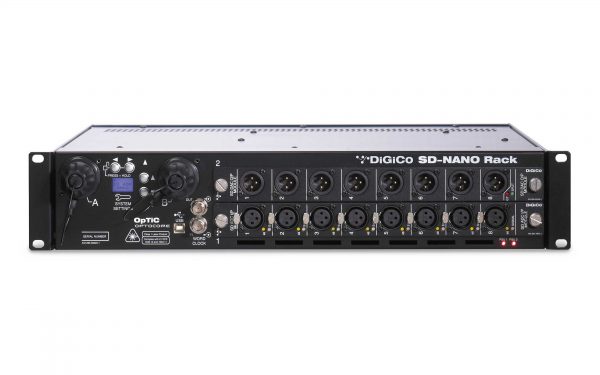
- Ultra-compact 2U rack
- Redundant Power Supplies
- Up to 16 I/O across 2 card modules
- Supports the full range of SD card options
The tiny 2U rack with massive DiGiCo I/O
At just 2U, the SD-Nano Rack brings extraordinary flexibility to installations and live shows alike as part of DiGiCo’s comprehensive family of high sample rate, remote rack solutions, also including the SD and SD-MiNi racks.
The SD-Nano rack accepts both analogue and digital input and output cards including AES/EBU, Dante, AES-42, ADAT, HD-SDI and Aviom. For purely digital applications, the SD-Nano runs up to 16 ins and outs, while all analogue scenarios can benefit from a maximum of 16 ins or outs or any combination thereof in banks of eight (for example, eight in and eight out). The SD-Nano Rack is only available as an optically connected rack.
Ideal for projects that require maximum flexibility without sacrificing ease of use, the SD-Nano Rack is a crucial building block in the DiGiCo I/O family. No matter the size of the rack you choose, up to 14 DiGiCo I/O racks can run on a single optical loop, while as many as 28 can be accommodated on a dual loop system. This, coupled with the ability for any of the five consoles that can sit on one optical loop to address all inputs and individually address output slots on any rack, gives the engineer or system designer unprecedented versatility.
SD-Nano Rack I/O Modules
SD-Nano Rack
A world of connectivity

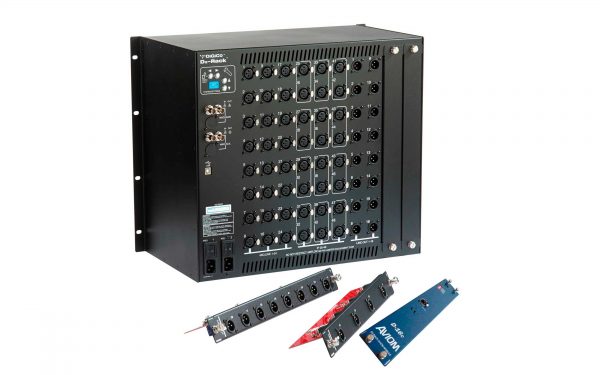
- 9U MADI connected high performance rack
- Option of 48 Mic In or 24 Mic/24 AES/EBU In
- Analogue and Digital output expansion
- Redundant power supplies as standard
Delivering 96KHz on BNC or CAT5
The D2-Rack spearheads DiGiCo’s digital connectivity with an expandable channel count and high sample rates, providing more than enough firepower to meet the needs of the most ambitious projects.
The compact 9U rack sports 48 inputs and 16 outputs as standard; these can be increased to 32 outputs by populating the two spare eight channel output slots with one or more of three available module options: Line out, AES or Aviom.
For further flexibility, the D2-Rack’s inputs can be specified as either 48 mic in or 24 mic/24 AES/EBU in.
Dual MADI ports, available on either BNC or DiGiCo Cat5e connections, either allow rack sharing at 48kHz between any two SD Series consoles or provide digital splits for recording. When combined, these ports create a single high definition 96kHz MADI connection with absolutely no reduction in I/O.
To ensure ultimate reliability the D2-Rack is equipped with dual redundant power supplies as standard.
D2-Rack
SD8 Specifications
General Specifications
- Faders 37 x 100mm Touch-Sensitive, Motorised
- Screens 1 x 15” (38cm) LCD High – Resolution Touch Screen
- Meters 38 x 20-Segment LED Bargraph
- 120 Input Channels
- Busses 48 assignable that can be configured as groups / auxillary busses + LR/LCR/LCRS Master Buss
- Solo Busses 2 Stereo Busses
- Matrix 16 x 16 Matrix (Additional to Busses Above)
- Control Groups 12, Selectable for VCA-style, Moving Fader, Mute Group
- Graphic EQ 24 x 32-band, Gain +/- 12dB
- Internal FX 16 Stereo FX Processors
- Local I/O 8 x Mic/Line I/O, 8 x AES/EBU I/O (Mono)
- MADI Interface 2 Redundant Interfaces, 75 Ohm BNC Connectivity
- Optic Interface Optocore (Optional Factory Fit Only)
- MIDI Interface In / Out / Through
- VGA Port DB-15 Mini-Female (1024 x 768 Resolution)
- USB Ports 3 x USB 2
- Light Connection 2 x XLR3 1.2 – 12V
- Ext Sync Word Clock, AES, MADI, Optics
- Headphone TRS Unbalanced / 8-600 Ohms 1/4 Inch Jack
- SD8 Dimensions 1347mm (w) x 811mm (d) x 251.7mm (h)
- SD8 Weight 65Kg (155Kg with Optional Flightcase)
- SD8 Flightcase 1517mm (w) x 1133mm (h) x 452mm (d) (Optional)
- SD8 Power Requirements 90-264 VAC, 47-63Hz Auto Sensing. 230VA Typical, 295VA Peak (Meters Full, Faders Moving
- Redundancy Internal PSU x 2
Audio Specification
- Sample Rate: 48kHz or 96kHz
- Processing Delay: 2ms Typical @ 48k (60 Stereo Channels, Stage Input Through L-R Buss to Stage Output) 1.1ms @96k
- Internal Processing: Up to 40-bit, Floating Point
- A>D & D>A: 24-bit Converter Bit Depth
- Frequency Response: +/- 0.6dB (20Hz – 20kHz)
- THD: <0.05% @ Unity Gain,: 10dB Input @ 1kHz
- Channel Separation: Better Than 90dB: (40Hz – 15kHz)
- Residual Output: <90dBu Typical
- Noise: (20Hz – 20kHz)
- Microphone Input: Better Than -126dB: Equivalent Noise
- Maximum Output Level: +22dBu
- Maximum Input Level: +22dBu
Processing Channel Specification
Input Channel
- Name: User-Defined / Presets
- Channel Selection: Mono / Stereo / Multi
- Input Routing: Main & Alternate Input
- Analogue Gain: -20 to +60dB
- Phase: Normal / Reverse
- Digital Trim: -40 to +40dB
- Delay: >1 Sec (Coarse & Fine Control)
- DiGiTuBe: Drive 0.01 – 50.0
- Bias 0 – 6
- LPF: 20 – 20kHz, 24dB/Oct
- HPF: 20 – 20kHz, 24dB/Oct
- Insert A: (Pre EQ/Dyn) On/Off
- Equalisation: 4 Band EQ: Parametric or Dynamic (Low/Lowshelf, Lower-Mid/Lowshelf, Upper-Mid/
Hi Shelf, Hi/Hishelf)
On/Off
Freq; 20 – 20kHz
Gain; +/- 18dB
Q: 0.1 -20 (Parametric) / 0.10-0.85 (Shelf)
Dynamic EQ On/Off
Over/Under
Band On/Off
Threshold; -60 – 0dB
Attack; 500us – 100ms
Release; 10ms – 10s
Ratio; 1:1 – 50:1 - Dynamics 1: Single or Multiband (3-Band) Compressor: On/Off
Threshold; -60 – 0dB
Attack; 500us – 100ms
Release; 10ms – 10s
Ratio; 1:1 – 50:1
Gain; 0 to +40dB with
Autogain Option
Link; Any Channel/Buss
Hi Crossover; 20Hz – 20kHz
Lo Crossover; 20Hz – 20kHz
Knee : Hard, Med, SoftDe-Esser: Threshold : 20us – 20ms
Release : 1ms – 100ms
Ratio : 1:1 – 50:1
Ess-Band : Listen On/Off
Ess-Band Filter Freq / Width: 20Hz – 20kHz - Dynamics 2: On/OffGate / Ducker: Threshold; -60 – 0dB
Attack; 50us – 100ms
Hold; 2ms – 2s
Release; 5ms – 5s
Range; 0 – 90dB
Key; Any Source
Key Listen
Freq/Width; 20 – 20kHz Compressor: On/Off
Threshold; -60 – 0dB
Attack; 500us – 100ms
Release; 10ms – 10s
Ratio; 1:1 – 50:1
Gain; 0 to +40dB with
Autogain Option
Link; Any Channel / Buss
Hi Crossover; 20Hz – 20kHz
Lo Crossover; 20Hz – 20kHz
S/C Source : Any Source
S/C Listen : On/Off
S/C Filter Freq/Width: 20Hz – 20kHz - Insert B: (Post EQ/Dyn) On/Off
- EQ/Dyn order: EQ/Dyn or Dyn/EQ
- Mute: Channel Mute / Hard Mute
- Solo: Solo Buss 1 / Solo Buss 2 / Both, Auto Solo
- Channel Safe: Input, EQ, Dyn, Aux, Pan, Fade/Mute, Inserts, Buss, Directs,
Full Safe - Output Routing: Buss, Insert A, Insert B, FX
Direct: On/Off, Pre-Mute / Pre-Fade / Post-Fade, Level +/- 18dB - Fader: 100mm Motorised Fader ∞ to +10dB
Processing Channel Specification
Aux / Group / Matrix Output
- Name: User-Defined / Presets
- Phase: Normal / Reverse
- Digital Trim: -20 to +60dB
- Delay: >1 Sec (Coarse & Fine control)
- DiGiTuBe: Drive 0.01 – 50.0
Bias 0 – 6 - LPF: 20 – 20kHz, 24dB / Oct
- HPF: 20 – 20kHz, 24dB / Oct
- Insert A: (Pre EQ/Dyn) On/Off
- Equalisation: 4 band or Dynamic (Low/Lowshelf, Lower-Mid/Lowshelf, Upper-Mid/Hi Shelf, Hi/Hishelf)
On/Off
Freq; 20 – 20kHz
Gain; +/- 18dB
Q: 0.1 -20 (Parametric) / 0.10-0.85 (Shelf)
Dynamic EQ On/Off
Over/Under
Band On/Off
Threshold; -60 – 0dB
Attack; 500us – 100ms
Release; 10ms – 10s
Ratio; 1:1 – 50:1 - Dynamics 1: Single or Multiband (3-band) Compressor: On/Off
Threshold; -60 – 0dB
Attack; 500us – 100ms
Release; 10ms – 10s
Ratio; 1:1 – 50:1
Gain; 0 to +40dB
with Autogain Option
Link; Any Channel / Buss
Hi Crossover; 20Hz – 20kHz
Lo Crossover; 20Hz – 20kHz
Knee : Hard, Med, Soft De-Esser: Threshold: 20us – 20ms
Release: 1ms – 100ms
Ratio: 1:1 – 50:1
Ess-Band: Listen On/Off
Ess-Band Filter Freq/Width: 20Hz – 20kHz - Dynamics 2: On/Off Gate / Ducker: Threshold; -60 – 0dB
Attack; 50us – 100ms
Hold; 2ms – 2s
Release; 5ms – 5s
Range; 0 – 90dB
Key; Any Source
Key Listen
Freq/Width; 20 – 20kHz Compressor: On/Off
Threshold; -60 – 0dB
Attack; 500us – 100ms
Release; 10ms – 10s
Ratio; 1:1 – 50:1
Gain; 0 to +40dB
with Autogain Option
Link; Any Channel/Buss
Hi Crossover; 20Hz – 20kHz
Lo Crossover; 20Hz – 20kHz
S/C Source : Any source
S/C Listen : On/Off
S/C Filter Freq/Width: 20Hz – 20kHz - Insert B: (Post EQ/Dyn) On/Off
- EQ/Dyn Order: EQ/Dyn or Dyn/EQ
- Mute: Channel Mute / Hard Mute
- Solo: Solo Buss 1 / Solo Buss 2 / Both, Auto Solo
- Channel Safe: Trim, EQ, Dyn, Fade/Mute, Inserts, Outputs, Full Safe
- Output Routing: Outputs, Insert A, Insert B, FX
- Fader: 100mm Motorised Fader ∞ to + 10dB