















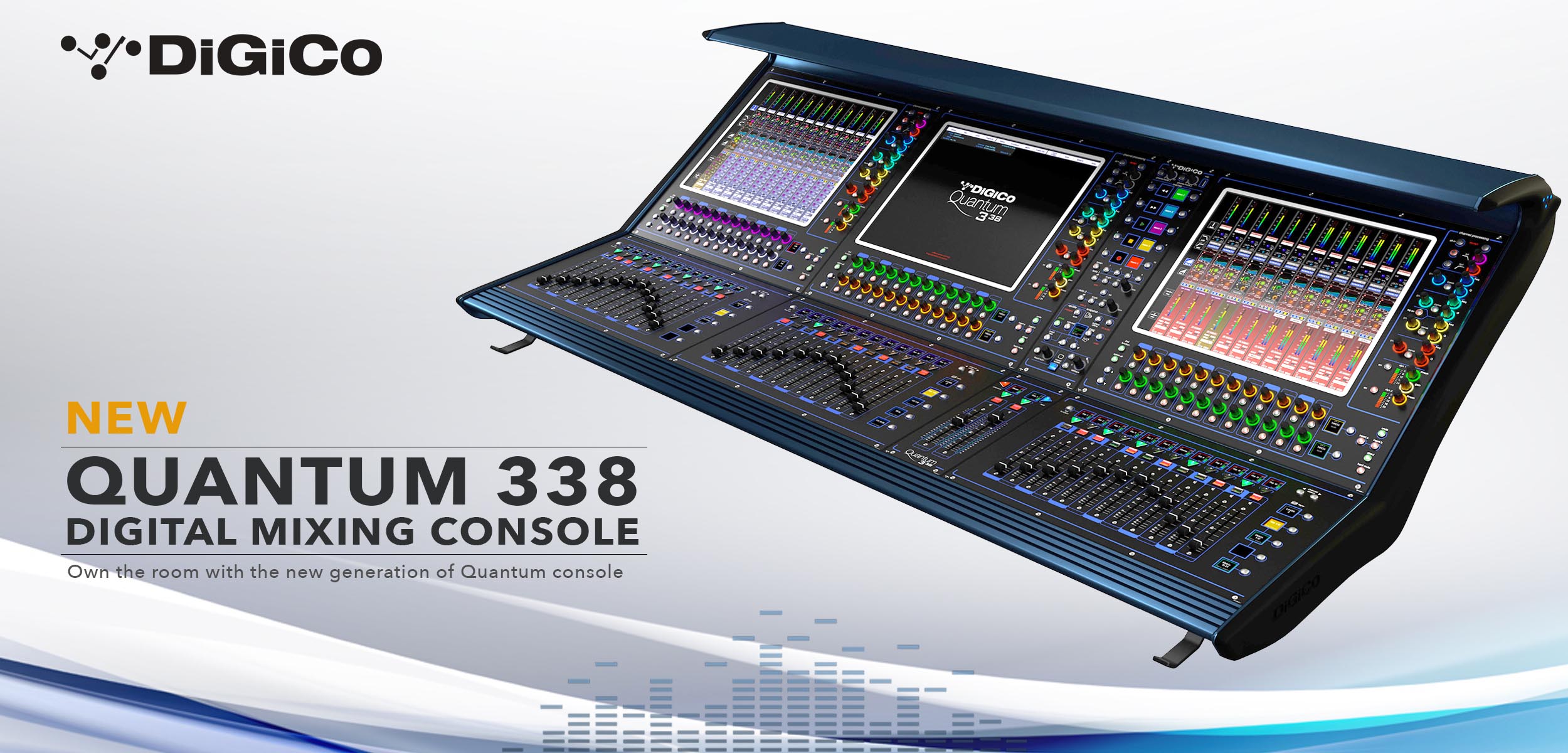

- 128 Input Channels
- 64 Aux / Sub-Group Busses
- LR/LCR/LCRS/5.1 Master Buss
- 24 x 24 Full Processing Matrix
- 286 Dynamic Equalizers
- 48/96 kHz Sample Rate
Quantum 338: Leap ahead
Representing a dramatic leap forward in power and connectivity within a remarkably compact format, Quantum 338 follows the Quantum 7 in defining the future of audio mixing.
Boasting a wealth of new design features and enhancements to create ultimate flexibility of use plus the speed of operation that only Quantum can deliver, Quantum 338 is based on seventh generation FPGAs with an entirely new system architecture. The console merges tried and tested workflows with immense processing muscle and bold innovation including a striking new dark mode.
Under The Hood – Ultimate Stadius!
Quantum 338 puts a trio of 17-inch, 1000 nit, high brightness multitouch screens at your disposal, with both the meter bridge and soft quick select buttons displayed on each screen for quick, intuitive operation. In addition, 70 individual TFT channel displays join the floating Quantum chassis with 38 100mm touch sensitive faders laid out in three blocks of 12 fader banks plus two dedicated user-assignable faders, each with high resolution metering.
Superior local audio connectivity and performance comes courtesy of new “Ultimate Stadius” 32-bit ADC and DAC conversion, which is built into the Quantum 338 as standard alongside six single or three redundant MADI connections, dual DMI slots and a built-in UB MADI USB recording interface.
Also included as standard are Mustard Processing channel strips, Spice Rack plugin style native FPGA processing options, Nodal Processing and True Solo.
I/O
With a maximum of 128 input channels with 64 busses and a 24 x 24 matrix, all with full channel processing, Quantum 338 takes built-in console I/O to new levels of performance.
The console’s 8 local mic/line inputs and eight local line outputs all feature 32-bit “Ultimate Stadius” converters, while users have access to 4 stereo AES/EBU in/out, triple redundant MADI in/out (which can also be configured as 6 MADI I/O at 48kHz), dual DMI card slots, support for dual second generation Optocore loops, a built-in UB MADI USB interface and more. Waves connectivity can also be added with a SoundGrid Interface card, adding up to an additional 64 I/O.
DMI-AMM
This card offers both the SD-Range and the S-Series consoles 48 channels of automatic microphone mixing which can be used in any console input channel.
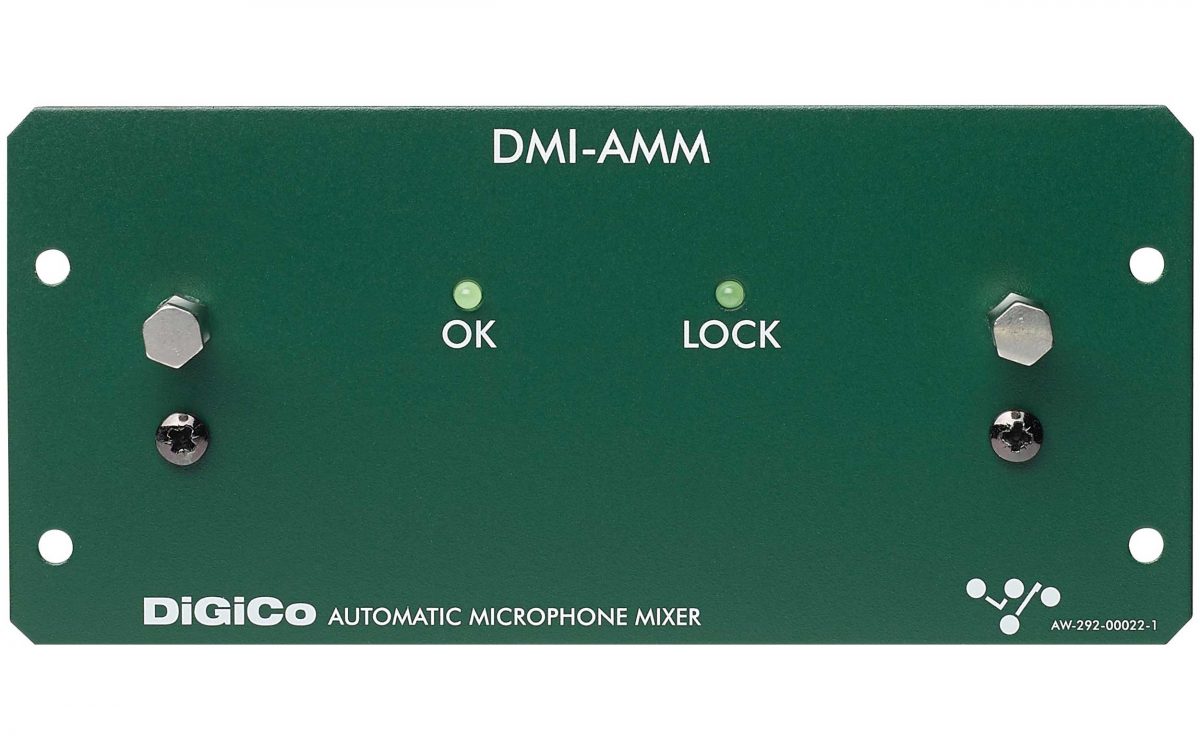
When dealing with live sound scenarios that involve several live microphones with unpredictable dialogue, mixing them can be a challenge for an engineer. DiGiCo are proud to offer the DMI-AMM (Automatic Mic Mixing) as a versatile solution for these issues.
The DMI-AMM system works by instantly fading up a microphone’s gain when one person begins to speak and reducing the gain of the other microphones. When the speaker pauses, all microphone levels return to medium gain, collectively matching the level of one microphone with the full gain share. The resulting effect is as if all speakers are sharing one microphone. When several people talk at once, the gain is shared between the speakers. Each channel is given a Share Meter, which is shown in percentage, not dB. This makes it easy to see what channels are taking the majority of the gain.
The DMI-AMM also allows adjustment of the relative sensitivity (or weighting) of the AMM on a per channel basis. This means that should one of the speakers be quieter than the others, they still have the ability to “take over” the system. Furthermore, the card features a vital noise floor control that imposes a lower limit on the level detector of all mics in the AMM to prevent a noisy mic from catching a disproportionate share of the gain.
This card offers both the SD-Range and the S-Series consoles two independent 48 channel automatic microphone mixers which can be used on any console input channel. Both the S-Series and SD-Range allow a Virtual AMM so that the AMM routing and parameters can be set before a card is inserted.
Main Features
- Two independent 48 channel automatic microphone mixers
- Weighting control on a per channel basis
- Share meter in percentage to show which channels are taking the majority gain share
- Noise floor control
- Simple integration into both the S-Series and the SD-Range software
- Virtual AMM to set up a session before the card is present
- Compatible with S-Series, SD12 and Quantum Range

DMI-ADC
This card provides 16 analogue inputs on 2 x 25 way “D” connectors. The ADC card is a line card only. There is no microphone amplifier or phantom power available. There is no gain control function for these inputs (only digital trim). Maximum input level +22dBu.

As a simple solution to expanding the local i/o of the S-Series, DiGiCo offer the DMI-ADC and the DMI-DAC. Both use 2 x 25 way “D” connectors to add either 16 analogue inputs or 16 analogue outputs. Both cards are compatible with S-Series, Quantum Range, SD12, Orange Box and 4REA4.
Main Features
- 16 analogue inputs
- 2 x 25 way “D” connectors
- Compatible with S-Series, Quantum Range, SD12, Orange Box and 4REA4

DMI-AES
This card provides 16 Inputs (8 pairs) and 16 outputs (8 pairs) on 2 x 25 way “D” connectors. All AES inputs are provided with sample rate conversion (SRC) by default. All AES outputs are synchronised to the mixer system clock.

Developed by the Audio Engineering Society (AES) and the European Broadcasting Union (EBU), this digital audio format was originally developed in 1985 and was the first professional digital audio format to gain widespread acceptance. There have been several revisions over the years. Also known as AES3 or IEC-60958 Type I, the data protocol includes up to two channels of up to 24-bit audio running at sample rates up to 96 kHz.
Multi-channel digital audio formats such as MADI have become popular, but AES3 is still a very useful format to distribute stereo signals (such as L/R mixer output) or to integrate stereo signal processors such as reverbs.
The DMI-AES provides 16 Inputs (8 pairs) and 16 outputs (8 pairs) on 2 x 25 way “D” connectors. All AES inputs are provided with sample rate conversion (SRC) by default. All AES outputs are synchronised to the mixer system clock.
Main Features
- 2 x 25 way “D” connectors
- 16 inputs (8 pairs) and 16 outputs (8 pairs)
- Sample rate conversions on all inputs
- Compatible with S-Series, Quantum Range, SD12, Orange Box and 4REA4

DMI-AVIOM
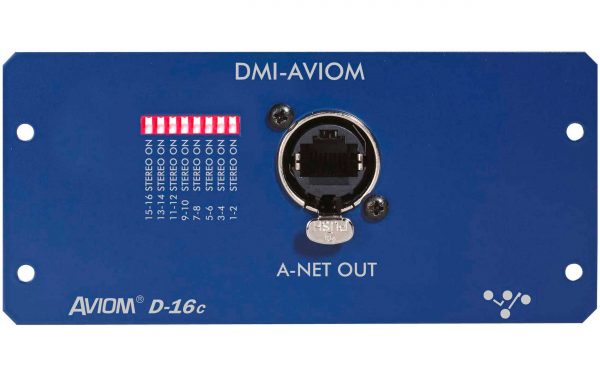
This card provides 16 output channels at 48kHz (with SRC) and Supports Aviom's proprietary A-Net Pro16 protocol. It has 1 Ethercon connection and faceplate DIP switched for Stereo output selection.

The DMI-AVIOM allows easy integration with Aviom’s personal monitoring systems through the use of their A-Net protocol. The card provides 16 output channels (8 stereo) at 48kHz with inbuilt sample rate conversion for seamless compatibility with consoles running at 48kHz or 96kHz and supports Aviom’s proprietary A-Net Pro16 protocol. It has 1 Ethercon connection and faceplate DIP switches for stereo output selection.
Main Features
- 16 output channels (8 stereo)
- Faceplate DIP switches for stereo output selection
- Inbuilt sample rate conversion
- Compatible with S-Series, Quantum Range, SD12, Orange Box and 4REA4
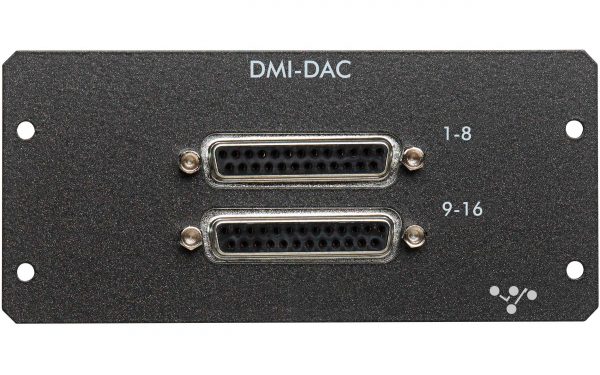
DMI-DAC
This card provides 16 analogue outputs on 2 x 25 way “D” connectors DAC card is line level only. Maximum output level +22dBu (Digital Full Scale)
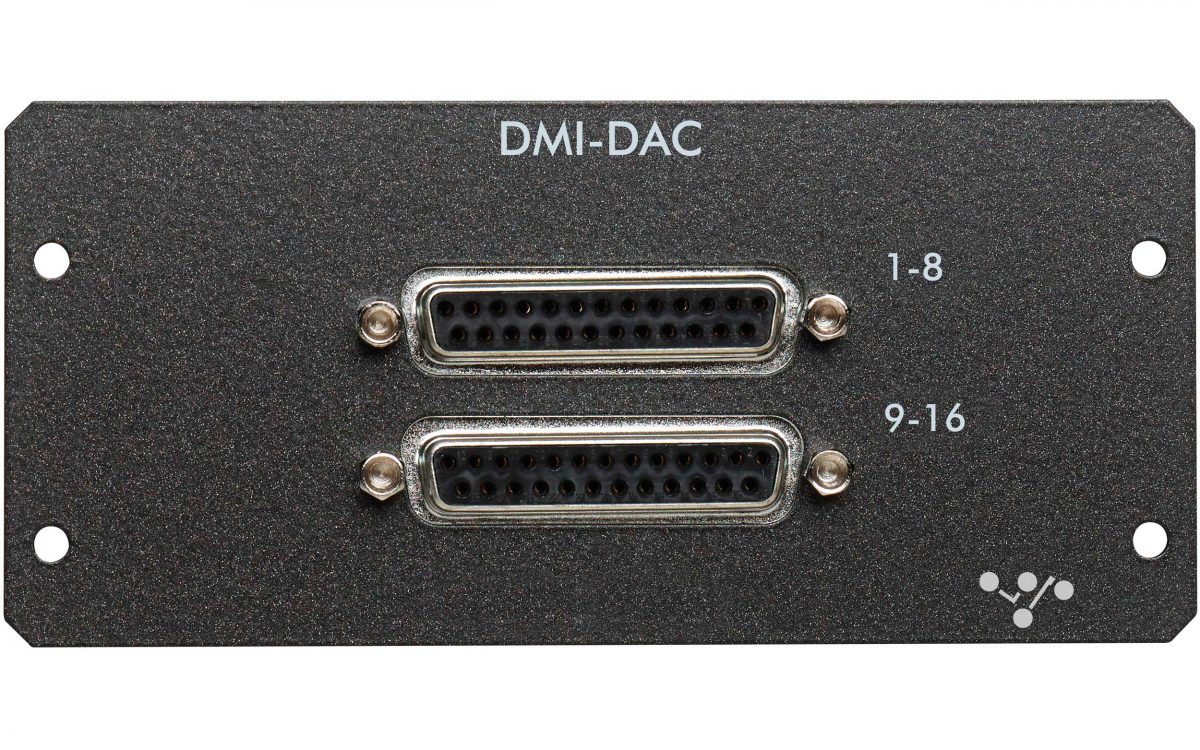
As a simple solution to expanding the local i/o of the S-Series, DiGiCo offer the DMI-ADC and the DMI-DAC. Both use 2 x 25 way “D” connectors to add either 16 analogue inputs or 16 analogue outputs. Both cards are compatible with S-Series, Quantum Range, SD12, Orange Box and 4REA4.
Main Features
- 16 analogue outputs
- 2 x 25 way “D” connectors
- Compatible with S-Series, Quantum Range, SD12, Orange Box and 4REA4
DMI-MADI-C
This card can be used to connect another DiGiCo device that uses RJ45 Standard MADI (64 channels in and out) at 48KHz or 96KHz or an SD Series DiGiCo Rack with the appropriate connector (D-Rack, D2-Rack)
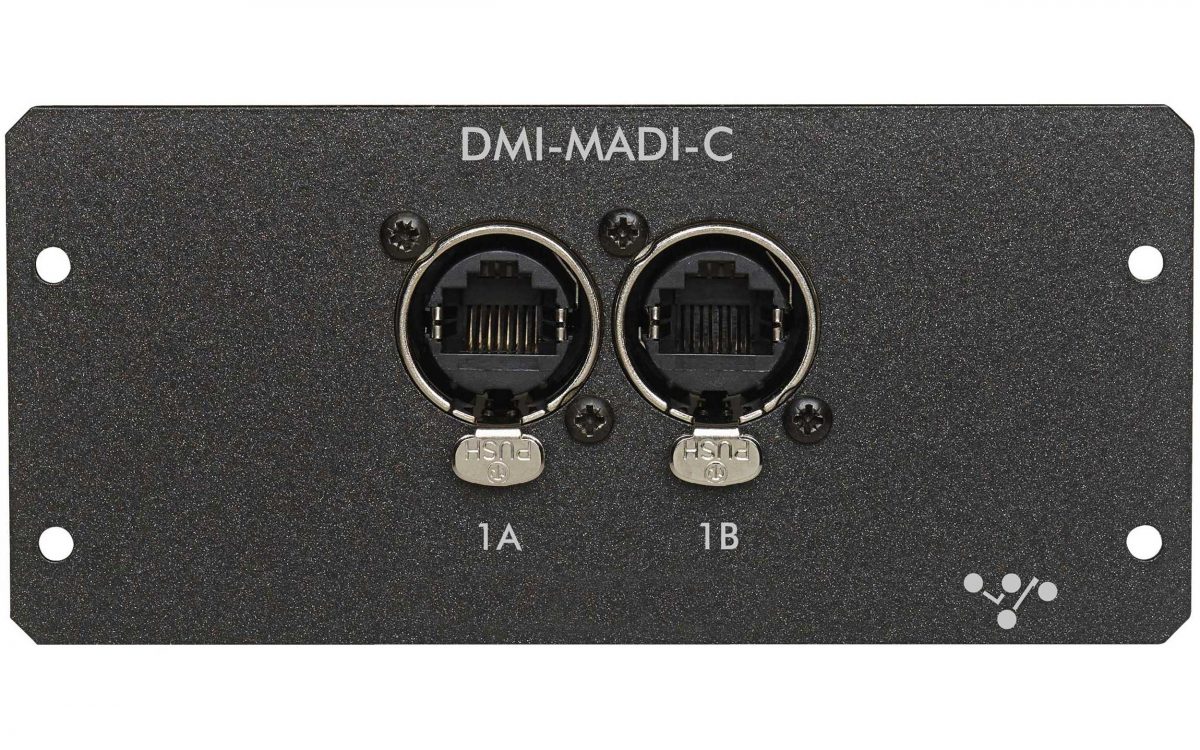
MADI (Multichannel Audio Digital Interface) is arguably one of the most popular protocols for transmitting high channel counts in professional audio. This is partially due to its ease of use, and the ability for cables to be run long lengths with minimal signal loss. Originally only capable of transmitting 56 channels, MADI is now capable of transmitting up to 64 channels.
DiGiCo offers two MADI DMI cards, each with different connector types. Both the MADI-B (BNC) and the MADI-C (RJ45) cards can be used to connect up to 64 channels of audio in and out at both 48kHz and 96kHz. At 48kHz, the B connection can be used as a redundant audio stream. Should the A stream fail during use, the B stream will seamlessly take over. At 96kHz, the B connection must be connected to provide the full channel count.
Main Features
- RJ45 connection
- 64 channels in and out at 48kHz and 96kHz
- Redundancy if working at 48kHz
- Only for use with DiGiCo audio over Cat5 devices
- Internal switches to determine whether connected to a console or a rack
- Compatible with S-Series, Quantum Range, SD12, Orange Box and 4REA4

DMI-MADI-B
This card can be used to connect a Standard MADI stream (64 channels in and out) at 48KHz or 96KHz or an SD Series DiGiCo Rack with the appropriate connector (D2-Rack, SD-Rack, SD-MINIRack)
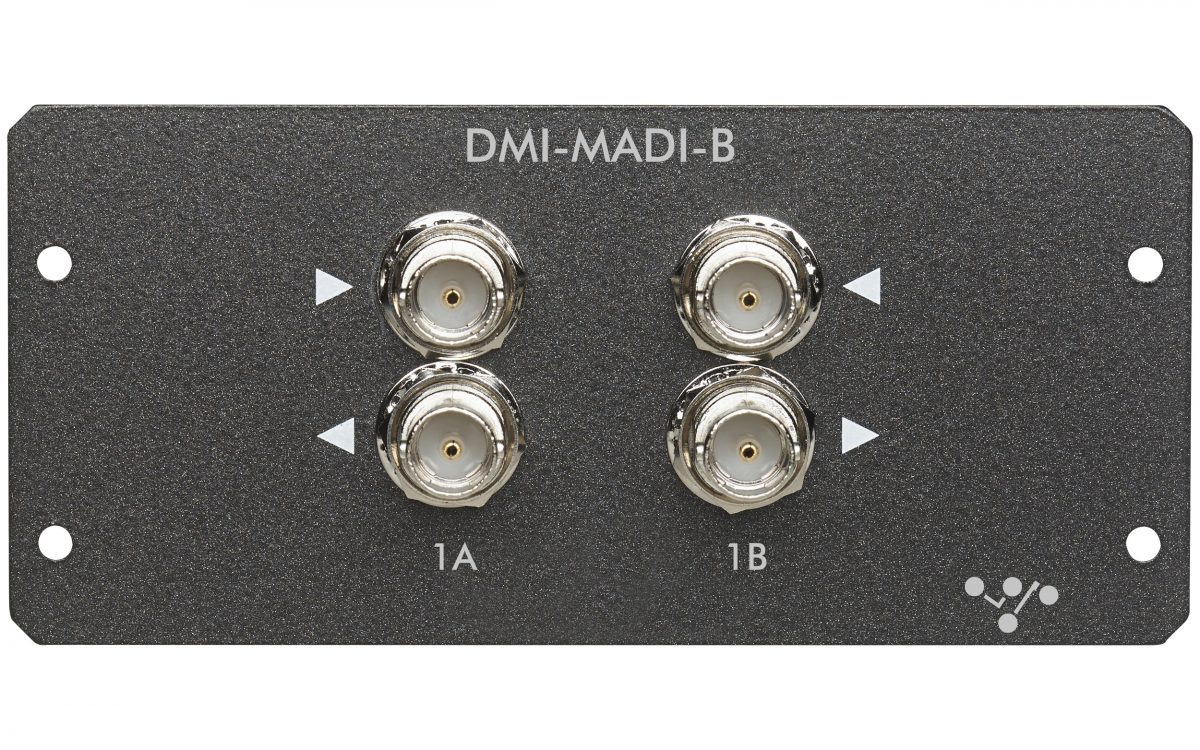
MADI (Multichannel Audio Digital Interface) is arguably one of the most popular protocols for transmitting high channel counts in professional audio. This is partially due to its ease of use, and the ability for cables to be run long lengths with minimal signal loss. Originally only capable of transmitting 56 channels, MADI is now capable of transmitting up to 64 channels.
DiGiCo offers two MADI DMI cards, each with different connector types. Both the MADI-B (BNC) and the MADI-C (RJ45) cards can be used to connect up to 64 channels of audio in and out at both 48kHz and 96kHz. At 48kHz, the B connection can be used as a redundant audio stream. Should the A stream fail during use, the B stream will seamlessly take over. At 96kHz, the B connection must be connected to provide the full channel count.
Main Features
- 75Ω Coaxial (BNC) connections
- 64 channels in and out and 48kHz and 96kHz
- Redundancy if working at 48kHz
- For use with any standard BNC MADI audio device
- Compatible with S-Series, Quantum Range, SD12, Orange Box and 4REA4

DMI-DANTE
This card provides 64 input and 64 output channels at 48KHz and 32 input and 32 output channels at 96KHz. It is provided with Primary and Secondary (backup) Gigabit Ethercon ports for connection to the Dante network.
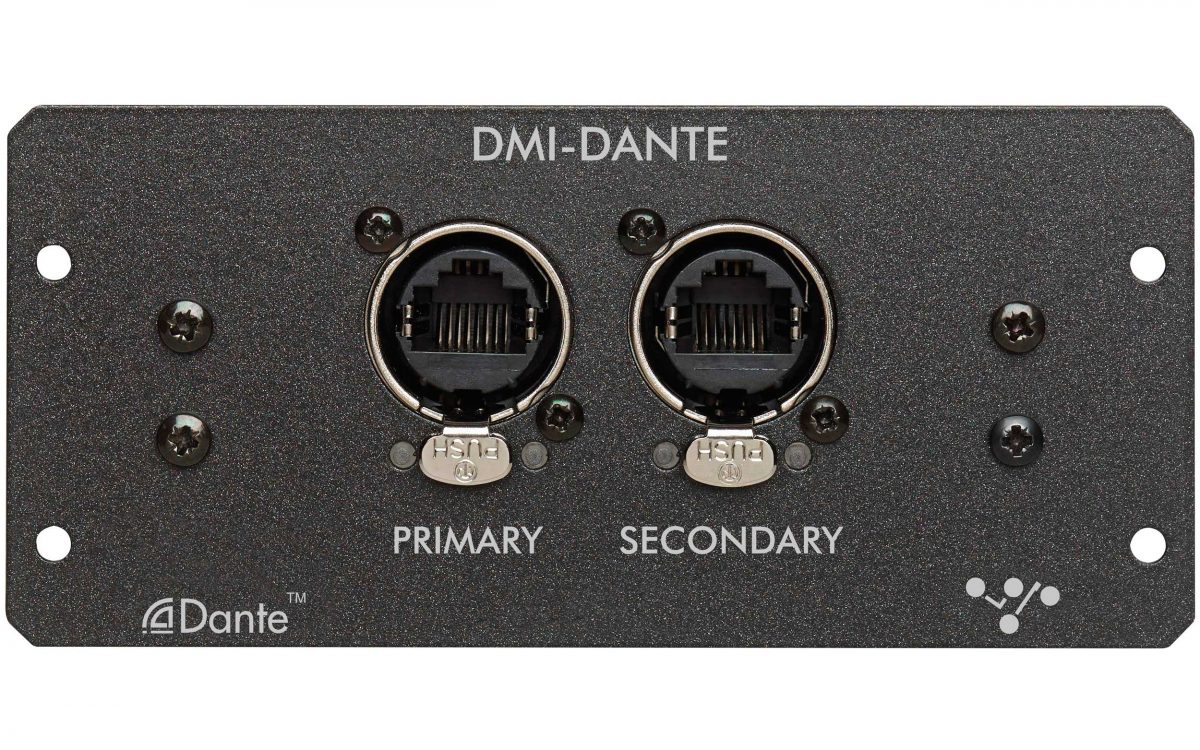
Audio over IP is becoming more and more sought after, due to the fact that it works over a standard IP network and can be sent over pre-installed infrastructure. Developed by Audinate in 2006, Dante provides uncompressed, low latency, multi-channel digital audio over IP and is a popular choice of protocol.
DiGiCo offer a Dante interface that allows 64 channels in and 64 channels out at 48kHz, and 32 channels in and out at 96kHz. The DMI-DANTE has a Primary and a Secondary port, both of which are Ethercon ports. The card has two modes that can be changed in Dante Controller. In Switched Mode, the ports are switched together. In redundant mode, the ports work as a redundant pair with separate IP addresses so that if the primary connection fails, the secondary connection will take over.
Main Features
- 2 Ethercon ports
- Switched mode switches the ports together
- Redundant mode allows the ports to work as a redundant pair
- 64 channels in and 64 channels out at 48kHz
- 32 channels in and 32 channels out at 96kHz
- Compatible with S-Series, Quantum Range, SD12, Orange Box and 4REA4

Quantum 338 Specifications
General Specifications
- Faders: 38 x 100mm touch-sensitive, motorised
- Screens: 3 x 17” LCD high – brightness, high – resolution touch screens
- Input Channels: 128
- Busses: Up to 64 Aux / Group busses with full processing Mono / Stereo / LCR / LCRS / 5.1
- Matrix: Up to 24 Input / 24 Outputs with full processing
- Control Groups: Up to 24, selectable for VCA-style, Moving fader, Mute Group
- Graphic Eq: 24 x 32-band, Gain +/- 12dB
- Internal FX: Up to 24 stereo effects comprising floating point reverbs and delay/chorus/pitch/enhancer
- Spice Rack: 8 mono / 4 stereo Rack Slots
- Mustard Proc: 36 Processing Strips
- Nodal Proc: 64 Nodal Processors
- Local I/O: 8 x 32bit mic/line I/O, 8 x AES I/O
- MADI interface: 6 x interfaces @ 48kHz, 3 interfaces @ 96kHz, BNC connectivity
- Optocore Interface: Optional (dual loop available)
- Sampling rates: 48kHz / 96kHz
- GPI/GPO: 16
- DMI: 2 x DiGiCo Multichannel Interface
- Waves: Optional
- Ext Sync: Wordclock, AES, MADI, Optocore
- Quantum 3 Dimensions: 1595mm (w) x 805mm (d) x 482mm (h)
- Quantum 3 Weight: 70Kg / 154lbs (198Kg / 437 lbs. with flightcase)
- Quantum 3 Flightcase: 1717mm (w) x 642mm (d) x 1144mm (h)
- Power Requirements 100V-240V, 50-60Hz, 295VA
Audio Specification
- Sample Rate: 48kHz or 96kHz
- Processing Delay: 1ms Typical (channel, SD Rack input through L-R Buss to Stage Output @ 96kHz)
- Internal Processing: Up to 40-bit, Floating Point
- A>D & D>A: 32-bit Converter Bit Depth
- Frequency Response: +/- 0.15dB (20Hz – 20kHz)
- THD: <0.002% @ Unity Gain, 0dB Input @ 1kHz
- Channel Separation: Better Than 120dB: (40Hz – 15kHz)
- Residual Output Noise: <100dBu Typical (20Hz – 20kHz)
- Microphone Input: Better Than -128dB Equivalent Noise
- Maximum Output Level: +22dBu
- Maximum Input Level: +22dBu
Processing Channel Specification
Input Channel
- Name: User-Defined / Presets
- Channel Selection: Mono / Stereo / Multi
- Input Routing: Main & Alternate Input
- Analogue Gain: -20 to +60dB
- Phase: Normal / Reverse
- Digital Trim: -40 to +40dB
- Delay: Up to 1.3s
- DiGiTuBe: Drive 0.01 – 50.0
Bias 0 – 6 - LPF: 20 – 20kHz, 24dB/Oct
- HPF: 20 – 20kHz, 24dB/Oct
- Insert A: (Pre EQ/Dyn) On/Off
- Equalisation: 4 Band EQ: Parametric or Dynamic (Low/Lowshelf, Lower-Mid/Lowshelf, Upper-Mid/
Hi Shelf, Hi/Hishelf)
On/Off
Freq; 20 – 20kHz
Gain; +/- 18dB
Q: 0.1 -20 (Parametric) / 0.10-0.85 (Shelf)
Dynamic EQ On/Off
Over/Under
Band On/Off
Threshold; -60 – 0dB
Attack; 500us – 100ms
Release; 10ms – 10s
Ratio; 1:1 – 50:1 - Dynamics 1: Single or Multiband (3-Band)Compressor:
On/Off
Threshold; -60 – 0dB
Attack; 500us – 100ms
Release; 10ms – 10s
Ratio; 1:1 – 50:1
Gain; 0 to +40dB with Autogain Option
Link; Any Channel/Buss
Hi Crossover; 20Hz – 20kHz
Lo Crossover; 20Hz – 20kHz
Knee : Hard, Med, SoftDe-Esser:
Threshold : 20us – 20ms
Release : 1ms – 100ms
Ratio : 1:1 – 50:1
Ess-Band : Listen On/Off
Ess-Band Filter Freq / Width: 20Hz – 20kHz - Dynamics 2: On/OffGate / Ducker:
Threshold; -60 – 0dB
Attack; 50us – 100ms
Hold; 2ms – 2s
Release; 5ms – 5s
Range; 0 – 90dB
Key; Any Source
Key Listen
Freq/Width; 20 – 20kHzCompressor:
On/Off
Threshold; -60 – 0dB
Attack; 500us – 100ms
Release; 10ms – 10s
Ratio; 1:1 – 50:1
Gain; 0 to +40dB with Autogain Option
Link; Any Channel / Buss
Hi Crossover; 20Hz – 20kHz
Lo Crossover; 20Hz – 20kHz
S/C Source : Any Source
S/C Listen : On/Off
S/C Filter Freq/Width: 20Hz – 20kHz - Insert B: (Post EQ/Dyn) On/Off
- EQ/Dyn order: EQ/Dyn or Dyn/EQ
- Mute: Channel Mute / Hard Mute
- Solo: Solo Buss 1 / Solo Buss 2 / Both, Auto Solo
- Channel Safe: Input, EQ, Dyn, Aux, Pan, Fade/Mute, Inserts, Buss, Directs,
Full Safe - Output Routing: Buss, Insert A, Insert B, FX
Direct: On/Off, Pre-Mute / Pre-Fade / Post-Fade, Level +/- 18dB - Fader: 100mm Motorised Fader ∞ to +10dB
Processing Channel Specification
Aux / Group / Matrix Output
- Name: User-Defined / Presets
- Phase: Normal / Reverse
- Digital Trim: -20 to +60dB
- Delay: Up to 1.3 sec
- DiGiTuBe: Drive 0.01 – 50.0
Bias 0 – 6 - LPF: 20 – 20kHz, 24dB / Oct
- HPF: 20 – 20kHz, 24dB / Oct
- Insert A: (Pre EQ/Dyn) On/Off
- Equalisation: 8 Band EQ: 4 band Parametric and 4 band parametric or Dynamic (Low/Lowshelf, Lower-Mid/Lowshelf, Upper-Mid/Hi Shelf, Hi/Hishelf)
On/Off
Freq; 20 – 20kHz
Gain; +/- 18dB
Q: 0.1 -20 (Parametric) / 0.10-0.85 (Shelf)
Dynamic EQ On/Off
Over/Under
Band On/Off
Threshold; -60 – 0dB
Attack; 500us – 100ms
Release; 10ms – 10s
Ratio; 1:1 – 50:1 - Dynamics 1: Single or Multiband (3-band)Compressor:
On/Off
Threshold; -60 – 0dB
Attack; 500us – 100ms
Release; 10ms – 10s
Ratio; 1:1 – 50:1
Gain; 0 to +40dB with Autogain Option
Link; Any Channel / Buss
Hi Crossover; 20Hz – 20kHz
Lo Crossover; 20Hz – 20kHz
Knee : Hard, Med, SoftDe-Esser:
Threshold: 20us – 20ms
Release: 1ms – 100ms
Ratio: 1:1 – 50:1
Ess-Band: Listen On/Off
Ess-Band Filter Freq/Width: 20Hz – 20kHz - Dynamics 2: On/OffGate / Ducker:
Threshold; -60 – 0dB
Attack; 50us – 100ms
Hold; 2ms – 2s
Release; 5ms – 5s
Range; 0 – 90dB
Key; Any Source
Key Listen
Freq/Width; 20 – 20kHzCompressor:
On/Off
Threshold; -60 – 0dB
Attack; 500us – 100ms
Release; 10ms – 10s
Ratio; 1:1 – 50:1
Gain; 0 to +40dB with Autogain Option
Link; Any Channel/Buss
Hi Crossover; 20Hz – 20kHz
Lo Crossover; 20Hz – 20kHz
S/C Source : Any source
S/C Listen : On/Off
S/C Filter Freq/Width: 20Hz – 20kHz - Insert B: (Post EQ/Dyn) On/Off
- EQ/Dyn Order: EQ/Dyn or Dyn/EQ
- Mute: Channel Mute / Hard Mute
- Solo: Solo Buss 1 / Solo Buss 2 / Both, Auto Solo
- Channel Safe: Trim, EQ, Dyn, Fade/Mute, Inserts, Outputs, Full Safe
- Output Routing: Outputs, Insert A, Insert B, FX
- Fader: 100mm Motorised Fader ∞ to +10dB
Mustard Processing
- Preamplifier Tubes:
Variable Drive
Odd / Even / Overdrive / Distortion / Crunch / Hi Distortion Presets
Variable Output Gain - Preamplifier Amp:
Variable Drive
Odd/Even 1st stage harmonics
Bias & Saturate control
Off/Odd/Even 2nd stage harm
Variable HF Boost
Variable Output Gain - Equalisation: 4 band EQ: Parametric (lowshelf / bell, lower-mid bell / all-pass, upper-mid bell / all-pass, hishelf / bell)
HPF & LPF 4th order filters - Dynamics 1: Classic VCA Compressor / Vintage VCA Compressor / Optical Compressor / FET Limiter
- Dynamics 2: Gate / Ducker