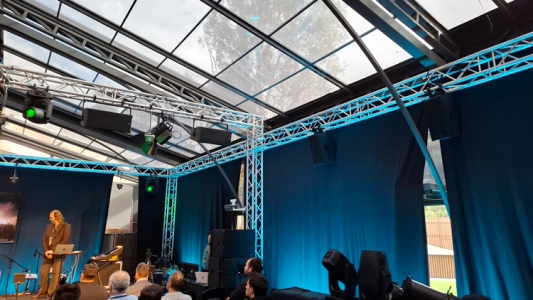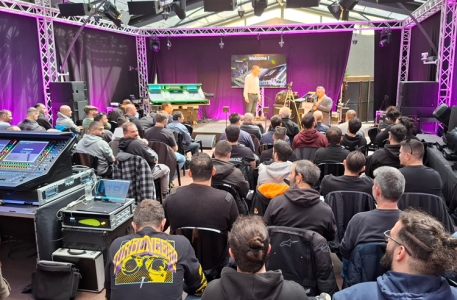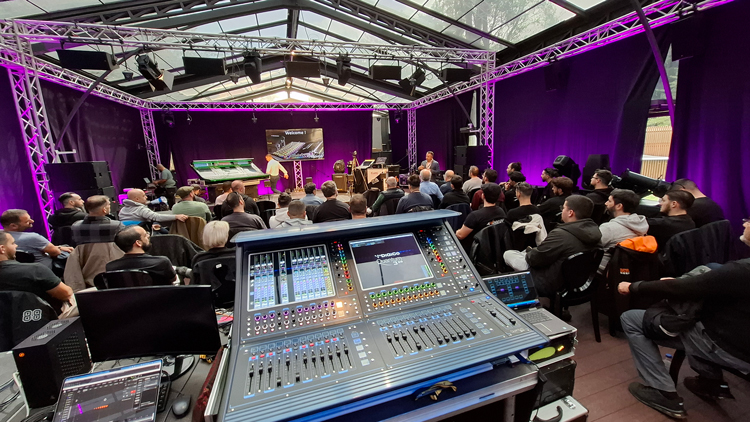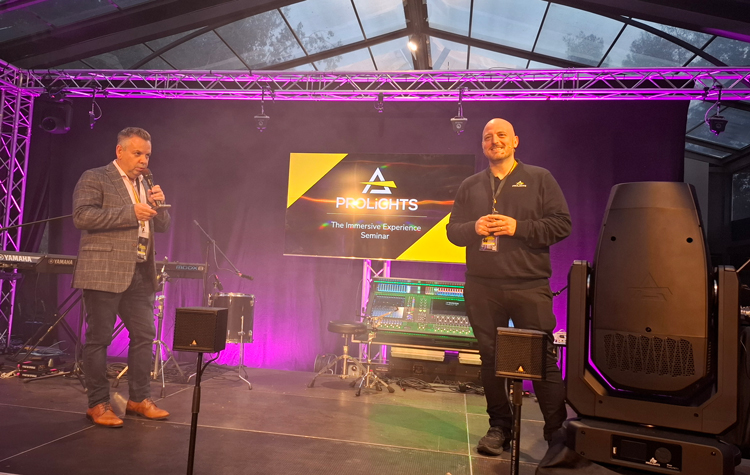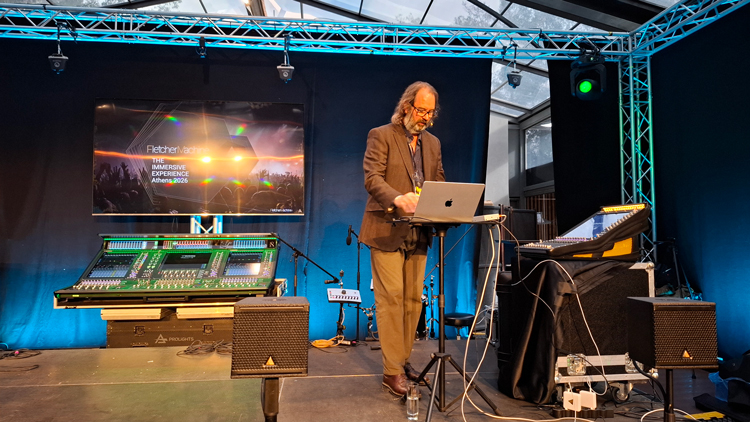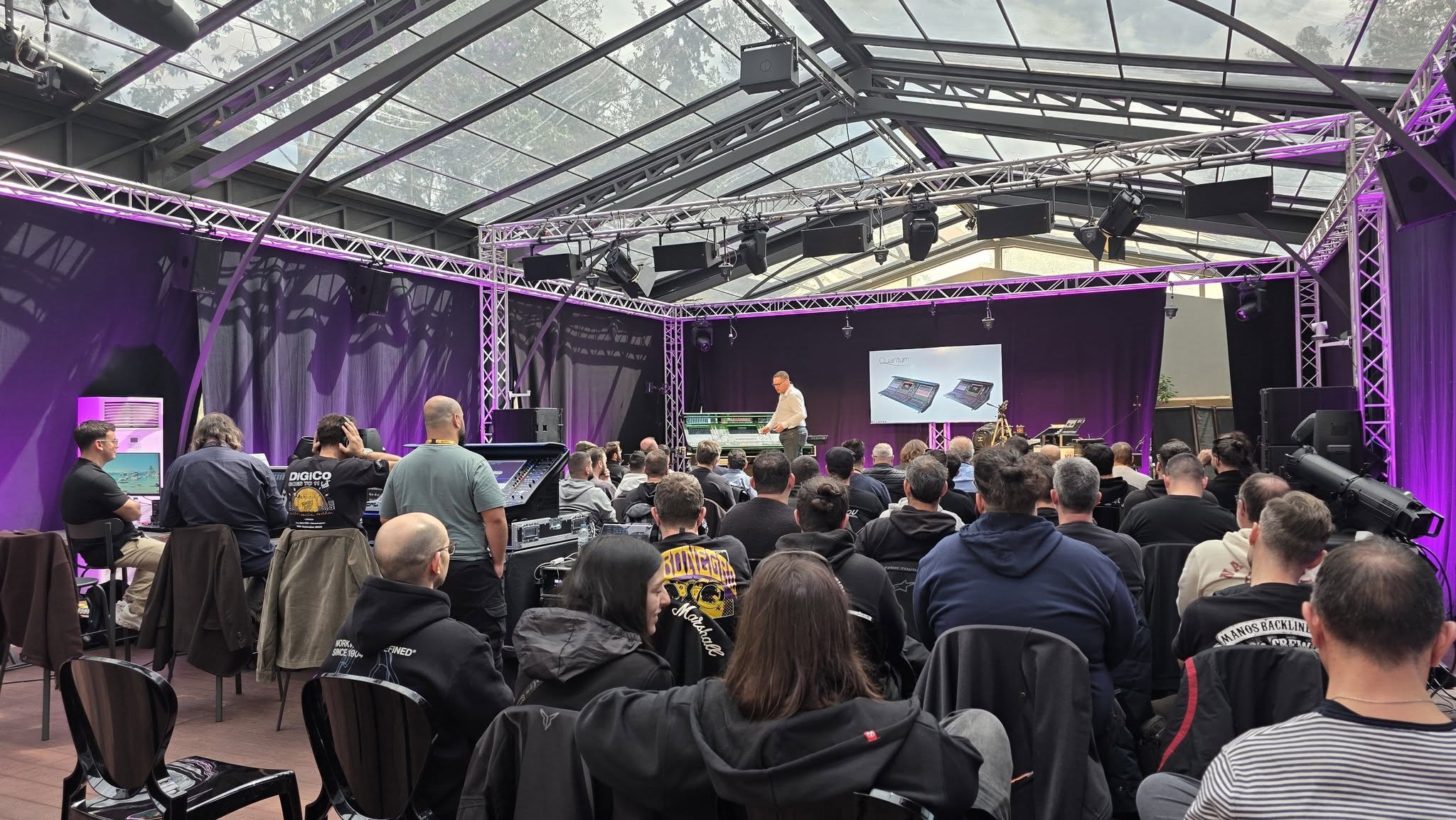

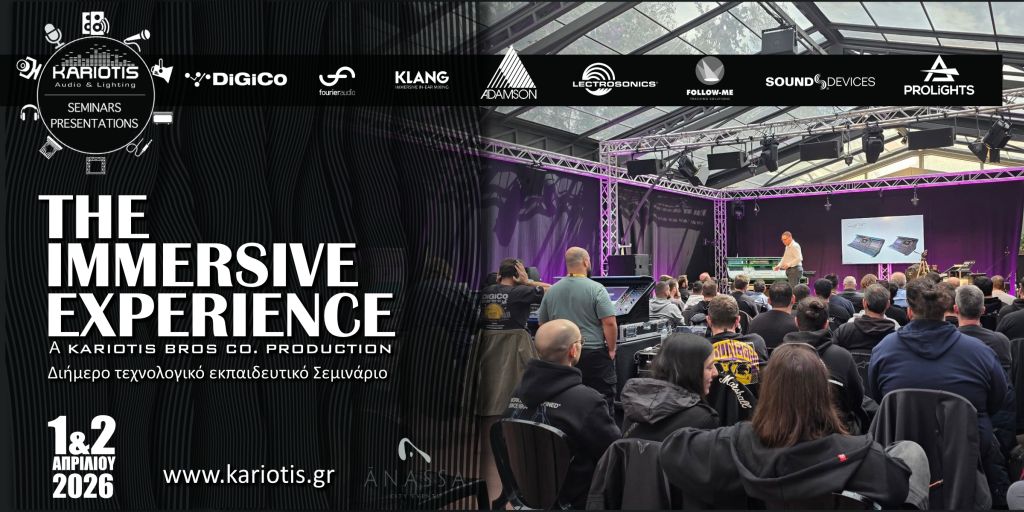
The seminar was introduced by Pantelis Kariotis, who presented the speakers’ plan and conveyed the essence of the Immersive concept that they had meticulously and painstakingly prepared for all attendees. aLive attended the second day of the presentation and reports…
DiGiCo news and total Eco–System
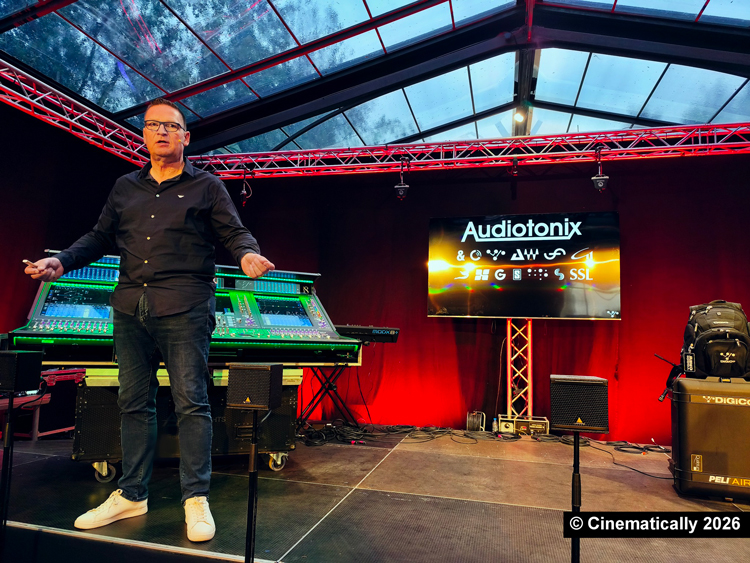
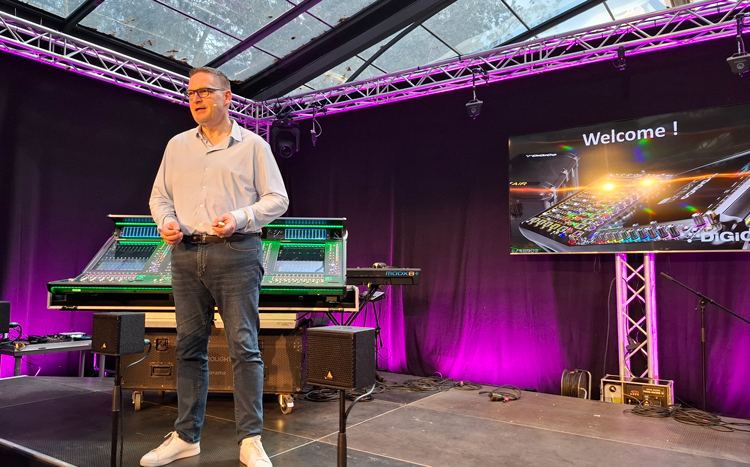
Jaap Pronk then took the floor, speaking about the DiGiCo ecosystem and emphasizing the importance of being part of a group of companies (Audiotonix) and how cooperatively and constructively their products work together for the benefit of the end-user.
As Jaap pointed out, this event is not just about Immersive but about integration, as he explained that all involved equipment and technologies would practically collaborate with each other.
Jaap began his presentation on DiGiCo by informing us that 8 out of 10 major tours last year used DiGiCo consoles. He started with the S series and moved on to Quantum, mentioning that user requests never stop. Thus, with Quantum (which started 8 years ago), they continuously offer more capabilities, while fully supporting the company’s philosophy of return on investment for those who invest in DiGiCo, as upgrades allow mixers to remain at the forefront of technology and demand for many more years.
Debut for the new DiGiCo 225 DS (Dual Screen)
The first new product Jaap presented was the new DiGiCo 225 DS (Dual Screen) with its two 17-inch touchscreens, which had long been a standing request from users (they asked for a 225 with two screens) and made its product debut on the day of the presentation. The new 225 DS supports 72 input channels, 36 busses, and a 12 x 12 matrix, all with full channel processing. Naturally, it includes Mustard Processing channel strips, Spice Rack plugin-style native FPGA processing options, Nodal Processing, and True Solo as standard.
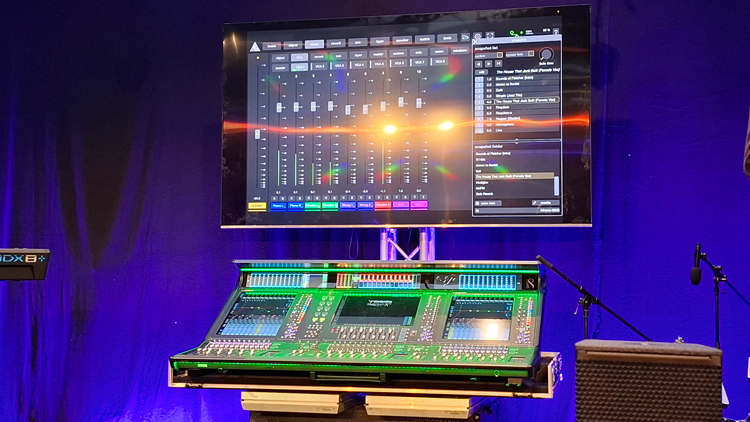
Of course, he presented DiGiCo’s flagship, the Quantum 852, which we had here—a console that incorporates dozens of new technologies and capabilities, with Jaap’s favorites being the channel Macros with assignable Macro buttons. Through the assignable macro encoders, he can route everything wherever and however he wants.
Truly, whatever you need during the show, the console brings it right in front of you.
As Jaap told us, 190 consoles have already been sold worldwide in less than 2 years since the console went into production.
For the end, Jaap saved the ‘big small’ Quantum 112, which was introduced a few months ago and is now beginning its commercial journey. He showed us how they presented it at their own outdoor festival last September, where the band and the sound engineer, with the Quantum 112 in his carry-on, arrived by helicopter, and the Live show started with minimal setup…
Regarding the DiGiCo ecosystem, he presented Harrison’s Live Trax, with the software fully controlled from the console and available for download to Quantum and SD owners.
Binaural Basics – the three factors of spatial hearing
Klang then took over with its new products, with Jaap explaining that our ears are immersive, not stereo, and that the three factors of spatial hearing
are level, time, and coloration.
Regarding Klang, he mentioned that it can be used with all digital mixers, and he
analyzed Klang’s basic philosophy and its two sides: mix the artist and help them do it themselves…
As for the hardware, he started with Vokal (12 mixes, 24 Mono or stereo sources, 48 or 96kHz), moved to Vokal plus, and from there to the even larger Konductor and Kontroller.
He also presented the new tiny KLANG:1 and KLANG:1 PRO
which serve as the ‘Swiss Army knife’ for KLANG, as they are pocket-sized and can manage a full binaural mix of up to 64 mono input channels, with extremely low latency of 0.25 ms. Also new was the KLANG:quelle XDM – anypoint to anypoint converter, and the KOS control software was also presented.
Sound Devices and Astral wireless series
This wireless platform is already in major productions and Live shows in just two years (since the company joined the Audiotonix group).
Jaap’s most interesting practical demo was when he used the Astral TX transmitter with 3 batteries. As he replaced the batteries while it was operating, the transmitter continued to function with 2 batteries, and even with 1 battery. Consequently, the user can replace batteries mid-program, and the wireless system remains active.
Jaap also activated multitrack via the microphone, which simultaneously supports intercom and NexLink 2-way, while the ARX32 receivers support 32 units from a single unit. Furthermore, the integration of SoundBase extends AstralComm to RF coordination, allowing users to change frequencies, rename transmitters, and view RF and NexLink RSSI, audio metering, mute status, channel names, and frequencies directly in SoundBase.
Jaap also presented the latest updates to AstralComm, the protocol that connects Astral Wireless with DiGiCo Quantum consoles. Specifically, we saw the collaboration between the Quantum 112 and the Astral series wireless mic, as the 112’s Channel-strip displayed visual information for all key parameters of the Astral transmitter (activation, mute, name, frequency, battery level, etc.).
It should be noted that remote control of the system is supported via IP address, even through a smartphone. Finally, through the new V22 software for the Quantum & SD series, simultaneous activation and deactivation of all mics or belt packs in a theater or concert is supported—a truly useful feature.
Fourier Audio and the new compact plugin host transform.go
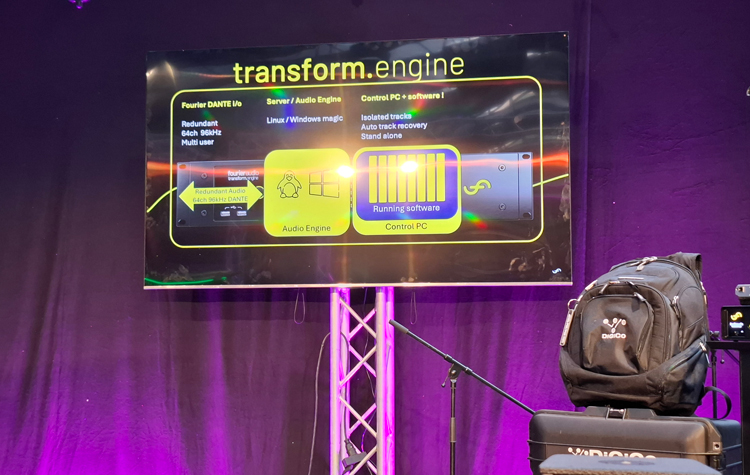
Regarding the presentation of Fourier Audio, the focus was on the new, lightweight, and compact plugin host transform.go, which debuted at ISE 2026 and is designed for modern touring and live sound workflows.
Also new is the low-latency audio protocol HYPERPORT, developed in collaboration with DiGiCo. With just 1.2 ms round-trip latency, it enables extremely fast and reliable audio connectivity for both transform.go and transform.engine.
Lectrosonics for all weather
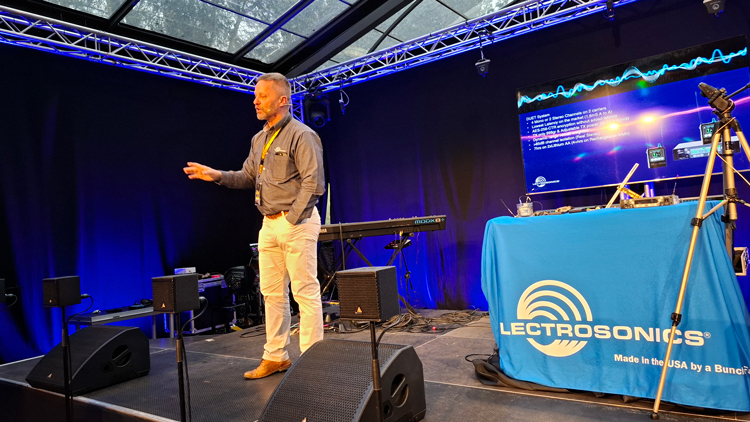
Before Jim Bakker, EMEA sales and tech support for Lectrosonics, took the floor, Pantelis Kariotis, in his introduction, presented the Swiss Voice Technologies (waterproof mics, etc.), which they have recently started representing and which work perfectly with the American company’s systems.
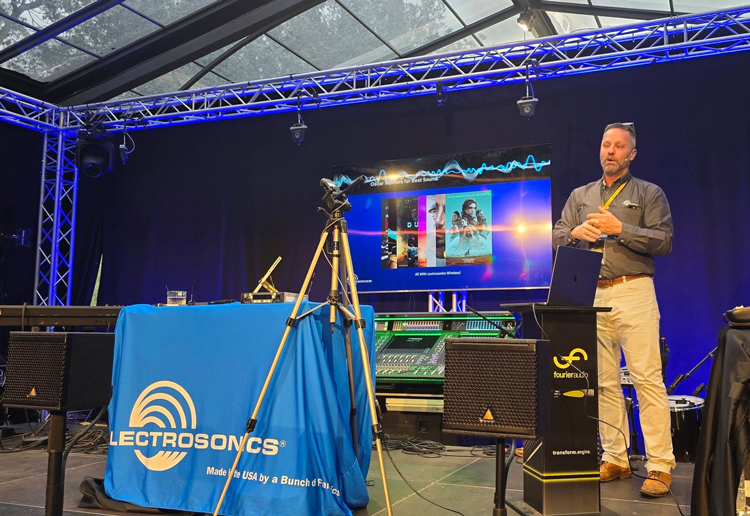
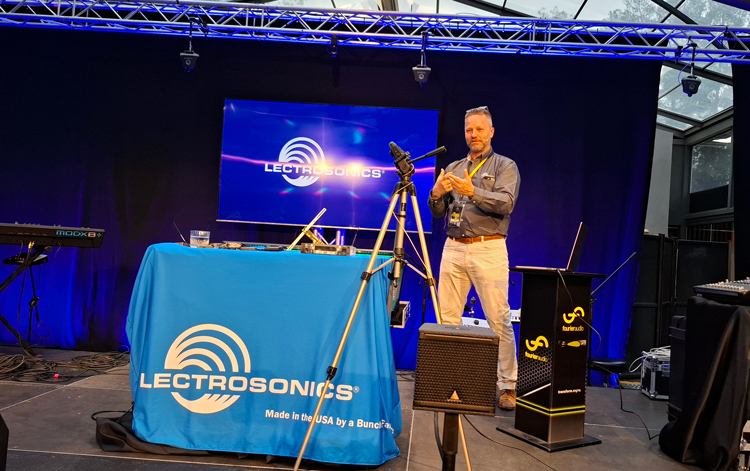
“We came from the desert,” Jim characteristically said, as the company is based in Rio Rancho, New Mexico. They also come from the film market, where Lectrosonics is a traditional ‘powerhouse,’ as its wireless systems are extensively used in top productions.
They also come from the broadcast sector, as dozens of TV stations and the most popular reality shows and game shows worldwide use their products.
Also on Broadway and in the theater market in general, they are far from unnoticed, as Jim characteristically told us they were initially ‘shut out’ until they appeared with the world’s smallest transmitter, which, besides being absolutely reliable, can be hidden anywhere thanks to its tiny size and weight. It is characteristic that 52 Lectrosonics channels are used in Frozen.
A major asset of their products is that they are full-function waterproof wireless systems, which is why they are preferred in action reality shows and game shows, as transmitters and microphones are subjected to particular stress. At this point, Jim dropped a Lectrosonics transmitter into a glass of water and left it there throughout his presentation. He threw another one forcefully on the floor several times after twirling it by the antenna like a lasso, and then he stepped on it himself with force, practically demonstrating how durable their products are in truly extreme usage conditions.
He informed us that their transmitters use a fixed antenna, not a detachable one, which, as he practically showed us, is extremely durable…
Regarding electromagnetic noise, Jim characteristically stated: “if we don’t want electromagnetic noise, we should turn off the sun”…
They have also entered the Live sector dynamically, with many guitarists, for example, placing the transmitter on their pedalboard without worrying about breaking it by stepping on it. He characteristically told us that Bonamassa uses their guitar system, while the Foo Fighters use their Lectrosonics in-ear systems that always travel with them.
The latency in their in-ear systems is only 1.6 ms, which is the lowest on the market, while the corresponding latency in their microphones is 1.4 ms, equally extremely low.
Regarding Wireless Design Software, he explained that they were the first to use acoustic measurements because they function like a wireless cable.
Flat frequency response is crucial for them, and as he characteristically stated, “anyone who manufactures wireless microphones and does not have a flat frequency and phase response should change jobs”…
Concluding, he spoke about the Lectrosonics Digital Ecosystem, presented the DSSM series of Digital Wireless Micro Transmitters that support the IP57 waterproofing specification (one meter in water for half an hour), and the dock charger with 3 units in one 1 PSU.
He also showed us the Dhu handheld microphone, the also waterproof DBSM & DBSMD transmitters, the DSQD 4-channel receiver, as well as the dual-channel transmitters (and camera HOP systems) DCHT and DCHR. For their IEMs, he told us they use FM transmission for coupling with a maximum frequency range of 35Hz-15kHz. They have low latency of +/-0.25ms and remarkable stereo channel isolation of 60dB.
Fletcher Machine – Spatial audio
Next presentation was by Arnaud Damien, ADAMSON sound specialist, on the Fletcher Machine. Arnaud started with the basics, stating that in a stereo PA system, the voice is heard from the center, and therefore, very few listeners hear the voice correctly in the center. The solution here is provided by the Spatial audio application with 5 speaker arrays in front for realistic listening and perception of space.
Subsequently, Arnaud proceeded to play mono, stereo, and spatial audio programs to help us perceive the differences.
In terms of theory, he spoke about Channel Vs Object and about time and amplitude, and then presented all the creative tools of the Fletcher Machine.
But let’s start from the beginning. The Fletcher Machine, an audio rendering processor that combines simple and user-friendly operation with highly efficient spatialization tools. ADAMSON’s Spatial Audio ‘engine’ uses width and time localization so that objects are perceived in their intended position, offering the listener a more direct connection to the music and a distinct immersive experience.
The rendered signals fed to the speakers are calculated from the perspective of the ‘objects’ themselves, thus ensuring optimal spatial coherence for most listening positions within a venue or the specific listening space we had here.
As for the ‘machine’ itself, the Fletcher Machine comes in 3 versions, with the Traveler Model being the most Compact and mobile version, which can handle either 32 or 64 inputs, combined with 32 outputs. It should be noted that the unit supports AVB/MADI or Dante at 48 or 96 kHz, and in any case, the latency does not exceed 1.33 ms.
Of course, the System Architecture, depending on the Fletcher Machine version, can be configured as stage 64*64 (or 96*32 or 32*96), stage extended 128*128, Traveler Lite 32*32 & Traveler 64*32.
It should be noted that the Virtual Fletcher Machine can be downloaded for free and runs on Windows and Mac operating systems. Arnaud presented the REMOTE software where, in the demo example, the percussion was ‘running’ with curves he drew himself, and then he added various effects, mainly reverb.
The listening sessions in Arnaud’s demo concluded with Frontal spatial + surround reverb, and we listened to a small jazz ensemble with vocals, followed by a large orchestra performing Mozart’s works… Of course, the platform also supports Binaural rendering, which means listening through headphones.
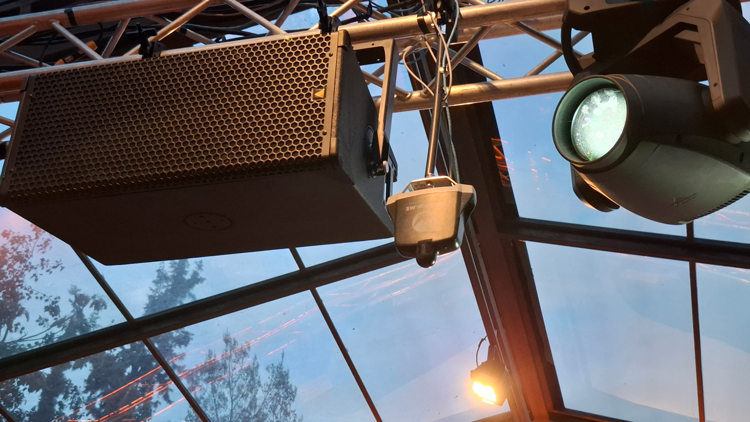
The listening system in the specially configured seminar/demo/listening room included 5 Adamson S10p speakers in front, 5 Adamson S7p speakers on the left and another 5 S7p on the right side of the room, and 5 S7p speakers in the back, while there were also 4 ceiling speakers. In front and across the stage, the tiny ultracompact 2-way coaxial Adamson IS5c were placed on stands, while on either side of the stage, 3+3 S119 subs per side were set up as ground stacks.
Follow Me – tracking solutions
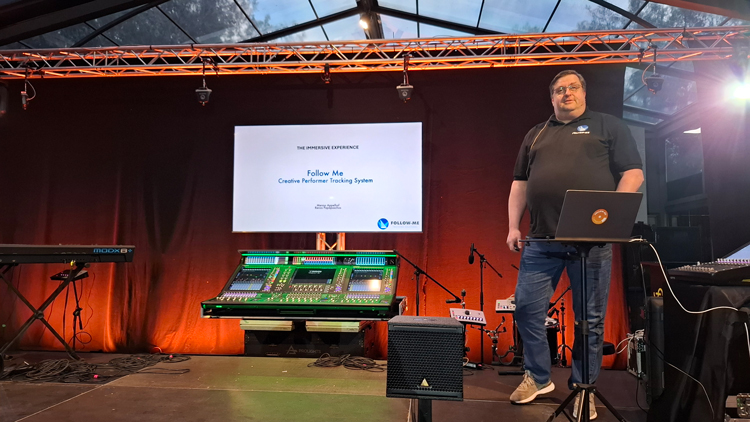
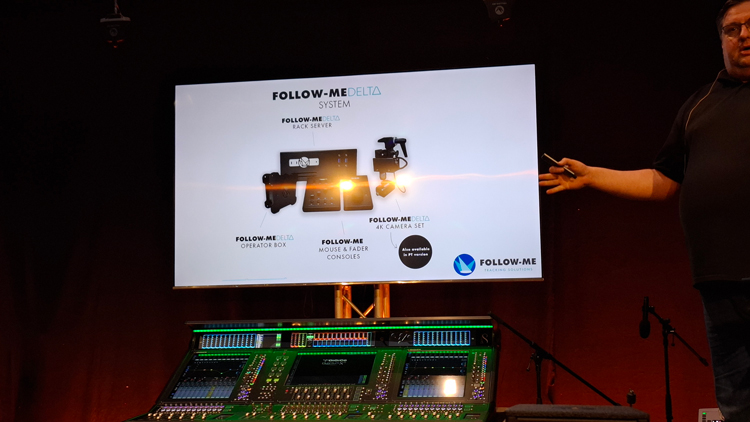
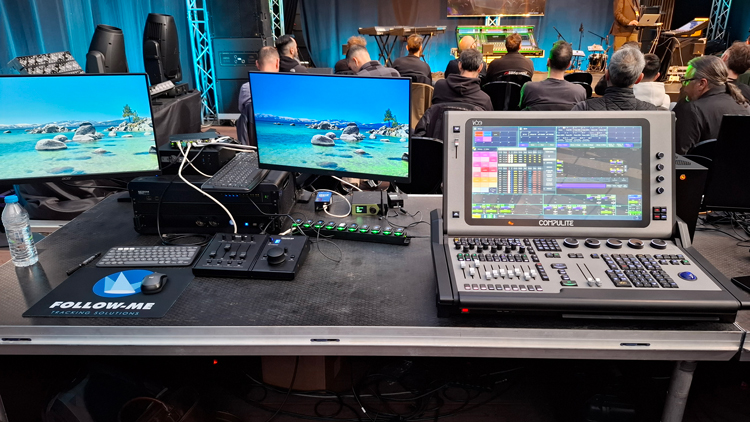
Menno Appelhof (FOLLOW-ME technical sales specialist) took the floor and introduced us to the Dutch company’s system, presenting its basic parameters. The company was founded by Gary Yates and Erik Berends in 2013, who brought their extensive experience from the entertainment industry and their background in large-scale projects over the past 25 years, creating highly innovative products and solutions, as well as corresponding software, for the entertainment industry.
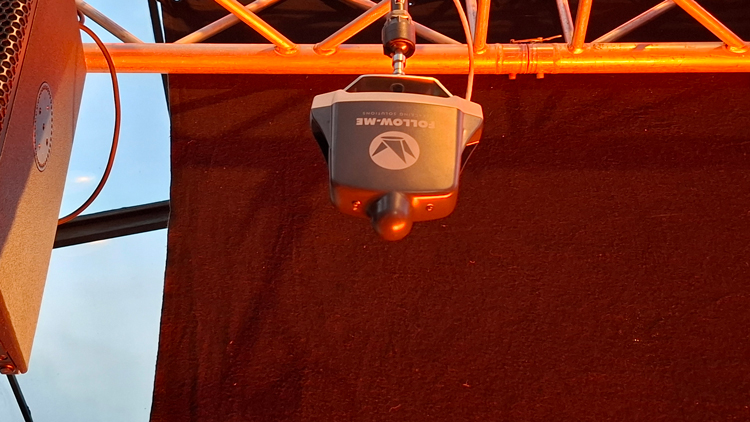
For the record, Menno told us that it all started in 2013 when the British band Suede requested an affordable, flexible, and easy-to-manage follow-spot solution for their performances. Thus, the first version of the system was implemented, leading to today’s two top systems in this field, Follow-Me 3D and Follow-Me Track-iT, which are manual and automatic performer tracking systems for the stage supported by custom-built hardware.
These Follow-Me software and hardware solutions are currently used by dozens of shows and tours worldwide. The system has two licenses, and the most important factor is the camera’s position, as it needs a clear view of the stage.
Renos Papapaschos, Follow-Me specialist for the Greek market, spoke to us about the practical application and setup of the system, explaining that we can divide the system into two categories, and one is what we can use in Greece, because the system, in addition to equipment, also requires extremely precise measurements.
Practically, as Renos explained, we place a camera, point it at the room, and then define the calibration points. It is important to place them with millimeter accuracy; otherwise, a difference of a few millimeters can ‘translate’ into several meters at the lighting fixture. The controller is a joystick that can also operate in manual mode. Practically, you define where it will follow you, so that when the target moves out of range, the lights fade out.
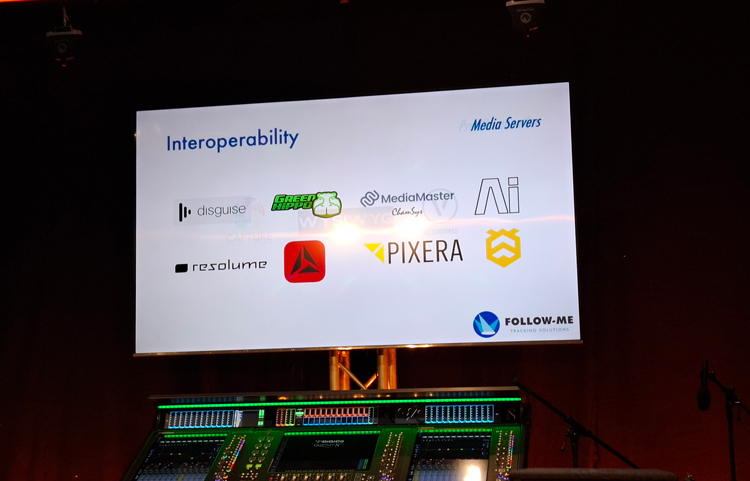
The system collaborates easily and quickly with any moving head, as long as it is ‘fast’ and executes commands instantly. The connection method is via RDNET, and control supports two universes.
Once we measure the room, we then place the robotic fixtures, and the program informs us about the calibration accuracy of each robotic fixture.
We place the sensor at the highest point of our body so it can perceive the height where the light ends… The sensors communicate via RF.
Then we set up the anchors, and through a matrix, we see how they work and how they collaborate. If something interferes in between, they turn red…
Renos’s conclusion, which was the essence of his presentation, is that the system works and opens new avenues for many different productions. Thus, a production or rental company can propose an innovative and exciting solution to its clients, making any event even more impressive, whether it’s a Live show, a conference, a corporate event, etc. FOLLOW-ME can indeed upgrade any production…
The PROLIGHTS enlightened us
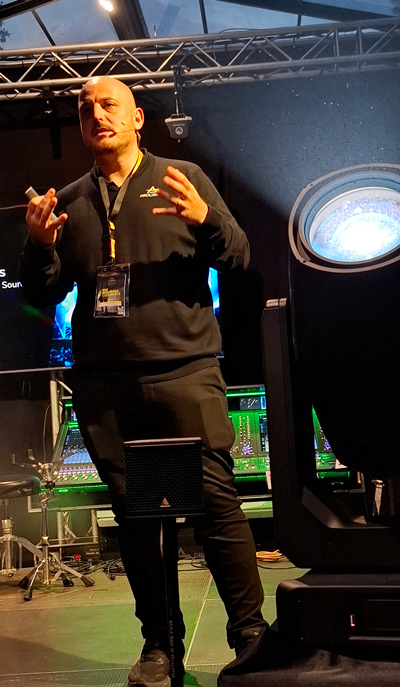
Next, sound passed the baton to lighting, and Fabio Sorabella – owner of PROLIGHTS – took the floor and introduced us to his company and its philosophy.
The Italian company was started in 1990 by his father, Franco, primarily with rental and production activities. However, from 2000 onwards, they focused exclusively on manufacturing lighting products.
They remain a family business despite having grown significantly since then, and their core philosophy for collaborations is to invest in long-term relationships, as they are not interested in fleeting sales.
They reinvest a significant portion of their revenues back into the company, and they produce many products as they cater to numerous diverse categories.
The film and television sector is a very large market for them, and equally important are the Live market and the architectural lighting sector. Fabio gave us some examples of recent installations, such as the Grammy Awards 2026, where 100 Halopix were installed for Lady Gaga, while 100+ blinders were used by Oasis.
At the Grand Egyptian Museum, which recently opened its doors, they installed a significant amount of lighting, and generally, many of their products have been installed in dozens of architectural lighting projects worldwide.
Fabio also informed us that they export to 70 countries, participate in 20+ exhibitions and international events, hold 80+ design patents, and the average age of their staff is 36 years old…
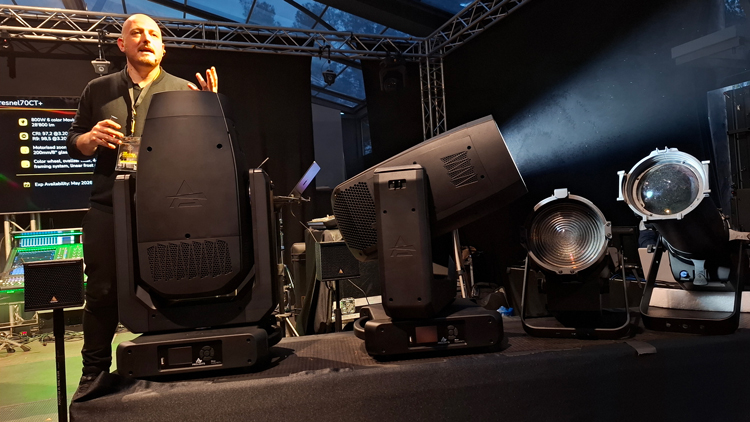
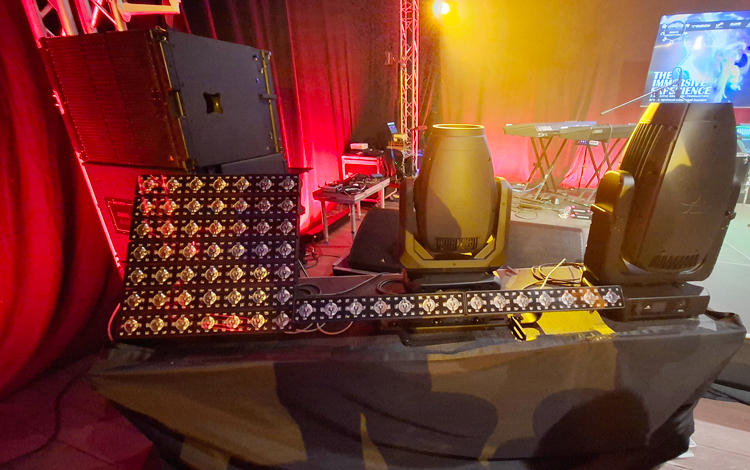
The products Fabio showed us here were the Spektra OS (introduced in 2019 and continuously evolving since then), the Muse Profile 70 and Muse Profile 70CT+ moving heads, the Muse Fresnel70CT+, as well as the Halustrip Duo & HaluPix Duo, which were recently introduced and are already enjoying excellent commercial success.
Regarding the Halustrip Duo bar, he mentioned that 3000 units have already been sold since its debut at the ISE 2026 exhibition in Barcelona…
The demo concluded with the presentation of the Astra Profile 300LTIP and its larger sibling, the Astra Profile 500LTIP…
IMMERSIVE Performances – from theory to practice
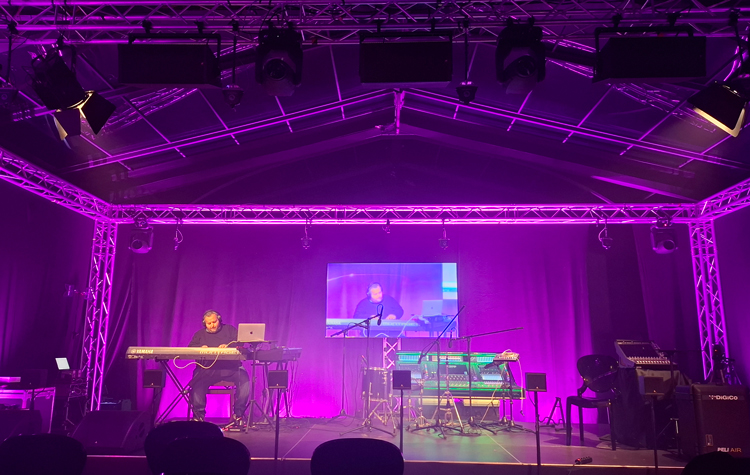
The presentation concluded with the transformation of theory into practice, as all the elements previously presented theoretically came together to form the puzzle of the immersive audio and visual experience that followed and concluded each day’s presentation (we remind you that it was a 2-day recurring event).
And so, technology met and served Music and spectacle.|
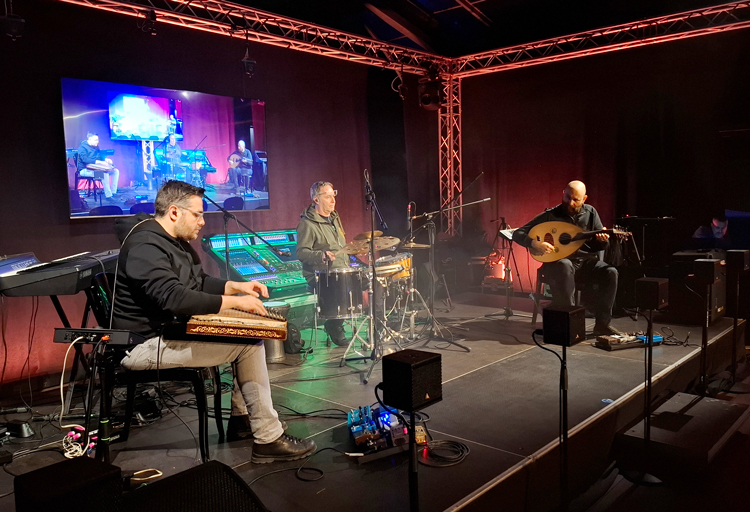
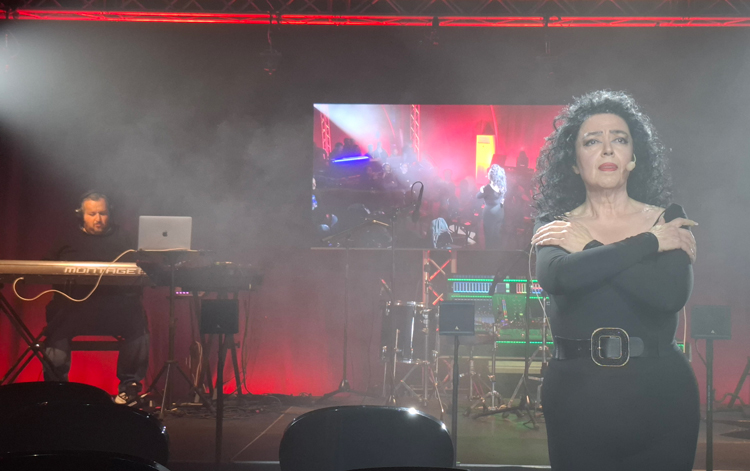
We listened to Livas Trio in a traditional and folk set, followed by the internationally renowned mezzo-soprano Markella Hatziano accompanied by piano soloist and creator Dimitris Keramidaki in an exclusive excerpt from the groundbreaking international project “LIGHT”. This project is set to have its world premiere in the United States next May, and as part of the seminar, the audience had the opportunity to experience a sample of it through the immersive dimension of the presentation.
The immersive result we experienced with Livas Trio was excellent, regarding spatial audio, the spaces, and the filling of the room by 3 musicians with static positions and very innovative equipment for a ‘traditional – folk set’.
The difference of immersive listening compared to a typical stereo listening experience was truly enormous and fully perceptible even by those unfamiliar with sound.
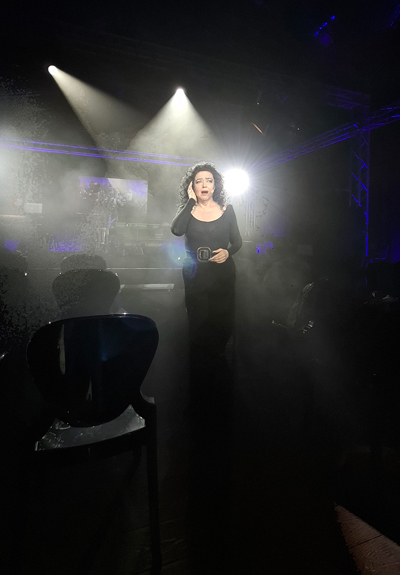
The climax, however, came with the set by Markella Hatziano and Dimitris Keramidaki, as it was supported by the orchestral richness of the pre-recorded and Live parts of the musical work, as well as by the voice, the interpretation, but primarily by the movement of mezzo-soprano Markella Hatziano, who did not even go on stage. Instead, she moved continuously through the space among the audience, transforming the room itself into a large stage. With these elements, the immersive result in sound and lighting (as well as visuals) was complete and impressive in every aspect. The sound and light harmoniously followed Ms. Hatziano’s movement with naturalness and precision, and she impressed with her performance and stage presence.
When asked by the undersigned after her performance about how she, as a performer, experienced this immersive condition, she spoke of an unprecedented and distinct impressive experience, with the sound and lights following her, and wished that technology would always support and open new horizons for art and the people who serve it.
An ideal example of how immersive technology can support art and create magic through realism.
Special mention here is needed for the system operators who participated in the Immersive experience, who were:
Lighting OPERATOR-Designer Nikos Kariotis, Sound Engineer Giannis Baxevanis, Adamson Fletcher Machine manager Arnault Damien, Follow Me setup managers Menno Appelhof, Renos Papapaschos and Nikos Kariotis, Adamson system managers Marios Kariotis and Christos Pappas, Image Flow manager Vassilis Kanakaris, Stage and Fourier setup manager Stavros Sykianakis, and Stage Change manager Christos Baris.
Main set-up managers Pantelis Kariotis and Giorgos Kariotis
Immersive epilogue
Kariotis Audio & Lighting has accustomed us for many years to organizing successful seminars and presentations with rich content, combining theory and practice, hands-on experience, and system listening sessions. In short, they have created a tradition of investing in organizing comprehensive presentations that require organization, time, work, and ‘backing’… Also, let’s not forget, it requires money…
This time, however, the Kariotis Brothers and all the executives and team of the company far exceeded even themselves, raising the bar even higher. This is because they organized a truly inspiring and comprehensive event, which was designed from the outset with a specific concept and for which executives from different manufacturing companies collaborated harmoniously.
They took the ‘buzzword’ (immersive) of modern audiovisual technology, analyzed it theoretically through the different technologies and products presented, and then transformed it into practice, i.e., into an auditory and visual experience. In other words, they organized a full-fledged immersive production of the immediate future, which, in my opinion, was aimed not only at technicians, rental companies, etc., but also at artists, concert producers, event planners, and executives of the broader entertainment community.
Everything we saw and heard theoretically, we finally experienced in practice, as the individual technologies presented earlier combined to create an immersive experience that one would rarely encounter in a production in our region.
And all this in a beautiful but acoustically challenging space, and against the weather, as the 2-day seminar coincided with storm Erminio visiting Athens.
Nevertheless, Immersive triumphed over Erminio, with attendance being very satisfactory on both days, and the real losers being those who did not attend…
For more information on all the above products and technologies, please contact Kariotis Audio & Lighting, whom we thank for the invitation and hospitality at Anassa City Events
Kariotis Audio & Lighting extends its sincere thanks to all participants in the “The Immersive Experience” seminar, held on April 1 & 2. Your presence, interest, and active participation made this two-day event truly special.
Without you, the experience would not have been as powerful and inspiring. Thank you, and we look forward to seeing you again at our next events!