
Mix anywhere
Designed to comfortably fit into a Pelican Air 1637 case, the new tiny console in the Quantum series, the Quantum 112, literally fits everywhere and travels with ease wherever you can imagine. The console can follow its owner or operator anywhere: on a plane, in a hotel room, backstage, in the studio, or even in a home office, making their life easier than ever when it comes to preparing mixes, setting up the console, and performing virtual soundchecks for a band or an entire show.
‘Dwarf’ with capabilities ‘Giant’…”
This is exactly what DiGiCo stated during the console’s launch, as the ‘small’ unit is based on DiGiCo’s latest 7th generation FPGA and offers 80 input channels, 24 aux/subgroup busses, LR/LCR master busses, and a 12×8 matrix, all with full channel processing. It also supports 12 control groups and two solos.
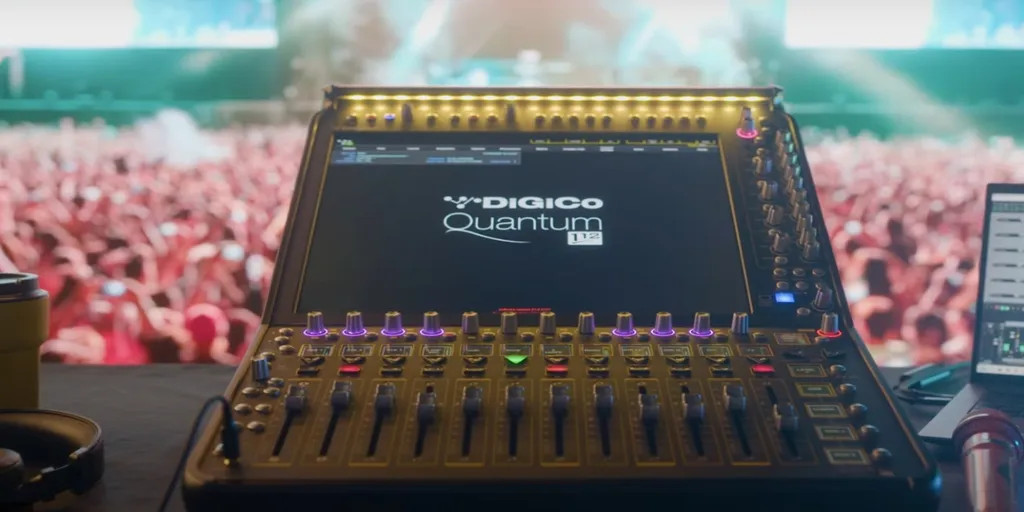
Its work surface is dominated by a 17-inch, 1000-nit, high-brightness multitouch screen with a meterbridge and soft quick select buttons.
It also features 18 individual TFT channel displays for even better user information and interaction.
Below the screen are the 100mm touch-sensitive faders, which are highly accurate in control with a particularly smooth feel regarding their movement.
Naturally, the new DiGiCo Quantum 112 incorporates the well-known and popular features of the Quantum series, such as Mustard Processing channel strips (20), Spice Rack plugin-style native FPGA processing options (6), and Nodal Processing (24). Also, 12 graphic EQs are available, as are 8 FX Rack slots.
I/O
The rear panel houses 64×64 Primary & Secondary Dante Ports on Ethercon connectors, 16 physical Mic/Line inputs, and 8 line outputs, both of which include the popular ‘Stadius’ 32-bit pre-amps and DACs. Also included are 1 AES/EBU input (2 channels) and 1 AES/EBU output (2 channels), 4 sets of MADI I/O, supporting 4 MADI interfaces or up to 2 redundant MADI interfaces at 48kHz or 2 interfaces at 96kHz. There are also 2 DMI slots and an integrated UB MADI (USB Type B audio I/O interface for recording and playback of up to 32 channels).
Local I/O:
Stadius 32-bit local I/O Sample Rate: 48kHz or 96kHz, Processing Delay: 0.5ms Typical (Mic in to Line out, no channel Processing), Internal Processing: Up to 40-bit, Floating Point, A>D & D>A: 32-bit Converter Bit Depth, Frequency Response: +/- 0.2dB (20Hz – 20kHz), THD+N (Mic In to AES Out): <0.002% @ 1kHz, 0dB gain, -10dBFS out, 22Hz-20kHz, THD+N (AES In to Line Out): <0.002% @ 1kHz, +16dBu out, 22Hz-20kHz, Channel Separation/Crosstalk (Mic In to Line Out): >100dB @ 10kHz, Residual Output Noise: <-93dBu Typical (20Hz – 20kHz), Equivalent Input Noise (EIN): <-127.5dBu A-weighted, 22Hz – 20kHz, Maximum Output Level: +22dBu, Maximum Input Level: +22dBu
MADI:
Integrated 32 Channel UBMADI, 4 x MADI BNC I/O @ 48k, 2 interfaces at 96k, 1 x UB MADI (USB Type B Audio I/O interface for recording and playback of up to 32 channels).
Optocore:
The console supports Optocore, providing a single loop that offers 504 additional audio paths at 48kHz and 96kHz. The Optocore Mode can be selected between MultiMode or SingleMode.
“Our new Quantum 112 is what they call ‘good things come in small packages’,” says DiGiCo CEO, Austin Freshwater. “We initially tasked the Research and Development (R&D) team with creating a rack-mountable Quantum console to replace the SD11, which is now 14 years old, and they absolutely outdid themselves. The Quantum 112 is not only rack-compatible but is also small and light enough when placed in a case to be below the magic size and weight numbers when traveling by air.”
“The initial brief really challenged our team, pushing us to research new materials, optimize design techniques, and reverse-shrink topologies while increasing performance,” confirms Michael Aitchison, DiGiCo’s Head of Research and Development. “Our previously smallest console, the SD11, weighs 24kg without packaging and 73kg with its flight case, so it wasn’t a true flypack product. The new Quantum 112 is almost 70 percent lighter, but still incredibly robust and much more powerful. We are extremely proud of its performance and are confident that our customers will be quite pleased with it.”
Technical Specifications – Capabilities
- Faders: 12 x 100mm touch-sensitive, motorized faders
- Screens: 1 x 17” LCD high-brightness, high-resolution touchscreen
- TFT Screens: 18 x Full Color TFT LCD Displays
- Redundancy: Internal PSUs x 2
- Input Channels: 80 Input Channels (Mono)
- 2 Solo Busses
- 12 input x 8 output Full Processing Matrix
- 8 Control Groups (CGs)
- Graphic Eq 12 x 32-band
- Internal FX: 6
- Spice Rack: 6 Internal Spice Rack Slots
- 20 Mustard Processing Strips
- 24 Nodal Processing 4 Band Parametric EQ / Dynamic EQ
- Stadius 32-bit local I/O
- Up to 4 MADI interfaces or up to 2 redundant MADI interfaces at 48kHz or 2 interfaces at 96kHz
- MultiMode Optocore Interface (Optional)
- Sample Rate: 48kHz or 96kHz
- GPI: 2 Jack (2 inputs)
- GPO: 2 GPO Jack (2 outputs)
- 2 x DMI Slots (up to 64 I/O per slot)
Audio Specification
- Sample Rate: 48kHz or 96kHz
- Processing Delay: 0.5ms Typical (Mic in to Line out, no channel Processing)
- Internal Processing: Up to 40-bit, Floating Point
- A>D & D>A: 32-bit Converter Bit Depth
- Frequency Response: +/- 0.2dB (20Hz – 20kHz)
- THD+N (Mic In to AES Out): <0.002% @ 1kHz, 0dB gain, -10dBFS out, 22Hz-20kHz
- THD+N (AES In to Line Out): <0.002% @ 1kHz, +16dBu out, 22Hz-20kHz
- Channel Separation/Crosstalk (Mic In to Line Out): >100dB @ 10kHz
- Residual Output Noise: <-93dBu Typical (20Hz – 20kHz)
- Equivalent Input Noise (EIN): <-127.5dBu A-weighted, 22Hz – 20kHz
- Maximum Output Level: +22dBu
- Maximum Input Level: +22dBu
Processing Channel Specification
Input Channel
- 80 Input Channels (Mono)
- Both Mustard and SD processing on all channels
- Main & Alternative input
- Analog Gain
- Phase Inversion Control
- Gain Tracking
- Digital Trim (-40dB to +40dB)
- Variable Delay (0ms to 1.3s)
- DiGiTube
- HPF/LPF (-24dB/Oct)
- 4 Band Parametric EQ / Dynamic EQ
- DYN 1: Compressor, Multiband Compressor, De-esser
- DYN 2: Gate, Duck, External Input Compressor
- EQ/Dyn Order Control
- 2 Insert Points per Channel
- Channel Mute & Hard Mute
- Channel Direct Outputs
24 Aux/Sub-Group Busses
- Digital Trim (-20dB to +60dB)
- Variable Delay (0ms to 1.3s)
- DiGiTube
- Merge Input
- Tone Generator
- HPF/LPF (-24dB/Oct)
- 8 Band EQ: 4 Band Parametric EQ and 4 Band
Parametric or Dynamic EQ - DYN 1: Compressor, Multiband Compressor, De-esser
- DYN 2: Gate, Duck, External Input Compressor
- EQ/Dyn Order Control
- 2 Insert Points per Channel
- Channel Mute & Hard Mute
12 input x 8 output Full Processing Matrix
12 Control Groups (CGs)
2 Solo Busses
12 x 32-band GEQs
8 Internal Stereo FX Processors De-lays - Audio Enhancer
- Choruses
- Pitch Shifters
- Reverbs
- 6 Internal Spice Rack Slots
- 6 band Dynamic Multiband Compressor/Expander
- 6 band Dynamic EQ
Mustard Processing
- 20 Mustard Processing Strips
- Tube
- Tube Emulation
- HPF/LPF (-24dB/Oct)
- 4 Band EQ: 2 Band Parametric EQ and 2 Band
Parametric EQ or All Pass Filters - DYN 1: Classic RMS/Peak Compressor, Vintage VCA
Compressor, Optical Compressor, FET Limiter - DYN 2: Gate, Ducker
24 Nodal Processing 4 Band Parametric EQ / Dynamic EQ
• DYN 1: Compressor, Multiband Compressor, De-esser
• DYN 2: Gate, Duck, External Input Compressor
Multiband Compressors available on every channel, Buss
and Nodal Processor
Dynamic EQs available on every channel, Buss and Nodal
Processor
DiGiTubes available on every channel & Buss
Virtual Soundcheck
True Solo function

